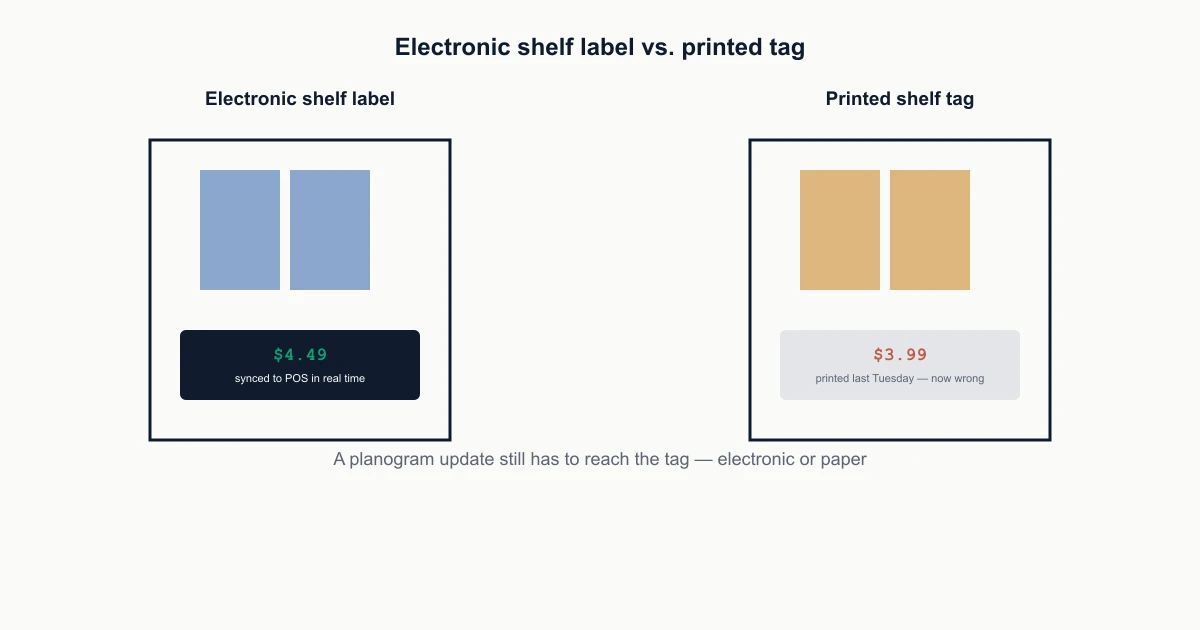
Digital price tags vs printed shelf tags isn't a simple "newer is better" comparison — each has genuine strengths, and the right choice depends heavily on a store's price-change frequency, budget, and tolerance for different kinds of failure.
Where printed tags still hold up
Low upfront and ongoing cost. Printed tags require a printer, labels, and staff time, but no specialized hardware network, software licensing, or integration work — for a store with infrequent price changes, this can be the more economical choice over time.
No dependency on a wireless network or power. A printed tag doesn't fail because of connectivity issues, battery depletion, or a software bug — its failure modes are simpler and more visible (a missing or clearly outdated tag is easy to spot).
Simplicity for low-complexity categories. For slow-moving, rarely-repriced categories, the labor savings of digital tags are smaller, which weakens the case for the added cost and complexity.
Where digital tags pull ahead
Speed of updates at scale. A price change across hundreds of SKUs can push to every label almost immediately, compared to printing and manually placing that many tags — this advantage grows with both store size and price-change frequency.
Labor savings for high-frequency categories. Categories with constant promotional activity or dynamic pricing benefit the most, since the alternative is continuous printing and placement work.
Consistency across a chain. A centrally managed digital system can push identical, correctly formatted pricing across every store simultaneously, reducing the store-to-store inconsistency that can creep into a manual printing process.
Where each introduces its own risk
Printed tags fail through human error — missed updates, wrong tag placed, or a tag that falls off and isn't replaced. Digital tags fail through system error — a bad data link, a sync delay, or a mapping mistake during a reset — which can be harder to spot at a glance because the label still looks like it's "working."
Making the choice
- Base the decision on price-change frequency first, since that's the variable most directly tied to the labor-savings case for digital tags.
- Factor in total cost of ownership, not just sticker price — digital systems carry software, integration, and maintenance costs beyond the hardware itself.
- Consider a mixed approach — some retailers deploy digital tags in high-change categories and keep printed tags in stable, low-change sections, rather than converting an entire store at once.
This connects to what electronic shelf labels actually solve — the two are usually worth planning together. Worth checking next: electronic shelf label rollout, which covers a closely related part of the same decision. This is closely tied to electronic shelf labels showing wrong price, and the two often need to be solved at the same time.
FAQ
Is there a store size below which digital tags rarely make financial sense?
This varies by category mix and price-change frequency more than store size alone, but very small, low-promotion-volume stores generally see a weaker labor-savings case than larger, high-activity locations.
Can a store run both printed and digital tags at once?
Yes, a mixed deployment — digital tags in high-frequency categories, printed tags elsewhere — is a common, lower-risk way to adopt the technology incrementally rather than converting an entire store in one rollout.
Which option is more resilient during a power or network outage?
Printed tags are inherently more resilient here, since they don't depend on ongoing power or connectivity — digital tags typically retain their last displayed price during an outage but can't update until service is restored.


