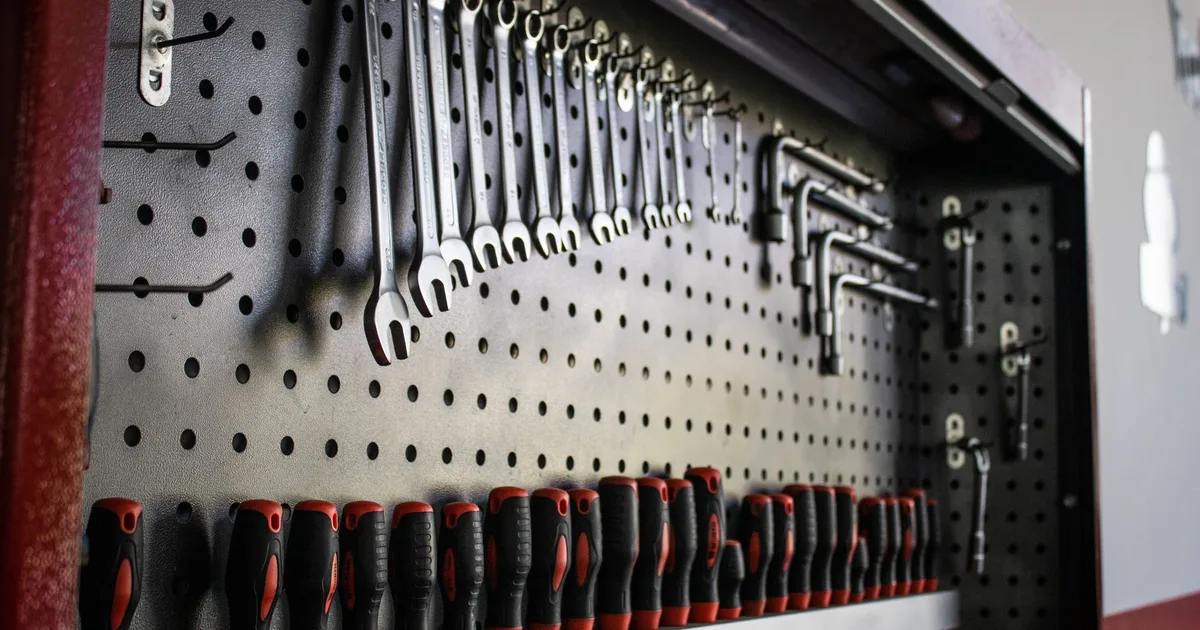
A pegboard planogram places each product on a specific hook position in the board's hole grid. Work it out in four steps: hook spacing from pack width, row spacing from pack height, units per hook from hook length and pack depth, then labels and back tags so stores can rebuild it.
A pegboard display holds blister packs, carded items and bags. They look simple, but the hole grid makes every measurement jump in fixed steps.
Work with the hole grid, not free space
Pegboard holes sit on a fixed pitch, commonly 1 in (25.4 mm) in North America; Wikipedia's pegboard article lists 25 mm for metric hardboard. Hooks can only go in holes, so every spacing rounds up to a whole number of holes.
Measure your own board before planning. Mixing a 25 mm plan with a 1 in board drifts by several millimetres per hook and the last column will not fit.
Space hooks across: width plus gap, rounded to holes
Hook centres = product width + gap, rounded up to the hole pitch
A pack 10 cm wide with a 1 cm gap needs 11 cm. On a 2.54 cm pitch that rounds up to 5 holes, or 12.7 cm (5 in). A 120 cm board then takes 9 hooks per row (114.3 cm), leaving an edge margin.
Measure the widest point of the pack, including header cards, not the product inside.
Space rows down: height plus finger room
Row spacing = pack height + 2 cm, rounded up to the hole pitch
An 18 cm tall pack needs 20 cm, which becomes 8 holes, or 20.32 cm (8 in). A 120 cm tall board fits 5 rows. Leave enough room for the hook's angle and the label strip; long hooks dip at the tip under load.
Heavy and bulky items go on the lower rows, small high-value or impulse items at eye level.
Units per hook: hook length vs pack depth
Units per hook = floor((hook length − 1 cm) ÷ pack depth)
The 1 cm keeps the front unit clear of the hook tip. A 15 cm (about 6 in) hook holding 2 cm deep packs holds 7 units. For the 9 × 5 board above that is 45 hooks and 315 units.
Pick hook length from sales, not habit. A slow seller on a 30 cm hook ties up stock; a fast seller on a short hook empties in a day. Check the hook's load rating for heavy items such as tools or large bags.
Labels and back tags on a pegboard planogram
Each hook needs its price label on label strips or a scan hook, and stores benefit from back tags: tags at the rear of the hook showing SKU, description and facings, so an empty hook still tells staff what belongs there. The Survey.com retail glossary defines these and related peg terms. Print hook positions on the planogram as row and hole numbers, for example "Row 3, hole 17".
Troubleshooting a messy peg wall
- Packs tangle or twist: hooks are too close; move to the next hole or use a narrower pack orientation.
- Front packs block the ones behind: headers overlap vertically; add one hole of row spacing.
- Hooks sag: load exceeds the hook rating or the board; use shorter hooks or move heavy items low.
- Empty hooks with stock in the backroom: capacity too low for sales; give the item two hooks or a longer one. See product facings for sizing.
- Impulse items need a second location: a clip strip in another aisle adds a small, temporary facing without changing the main wall.
Planning hook grids by hand is slow. In ShelfPlot you can lay out hanger fixtures with real pack sizes, so fit is checked as you place products. The free planogram maker is a quick way to test a wall.
Round up to the hole, never down
Every pegboard planogram decision rounds to the hole pitch. Round spacing up so packs never collide, pick hook length from sales, and label each position for an exact rebuild.
FAQ
How far apart should peg hooks be?
At least the pack width plus about 1 cm, rounded up to the next hole. On a 1 in pitch, a 10 cm pack typically needs 5 holes between hook centres.
What is a back tag on a peg hook?
A tag at the back of the hook showing the SKU, description and facings, so staff know what belongs on the hook when it is empty.
How many products fit on a peg hook?
Divide the usable hook length by the pack depth and round down.