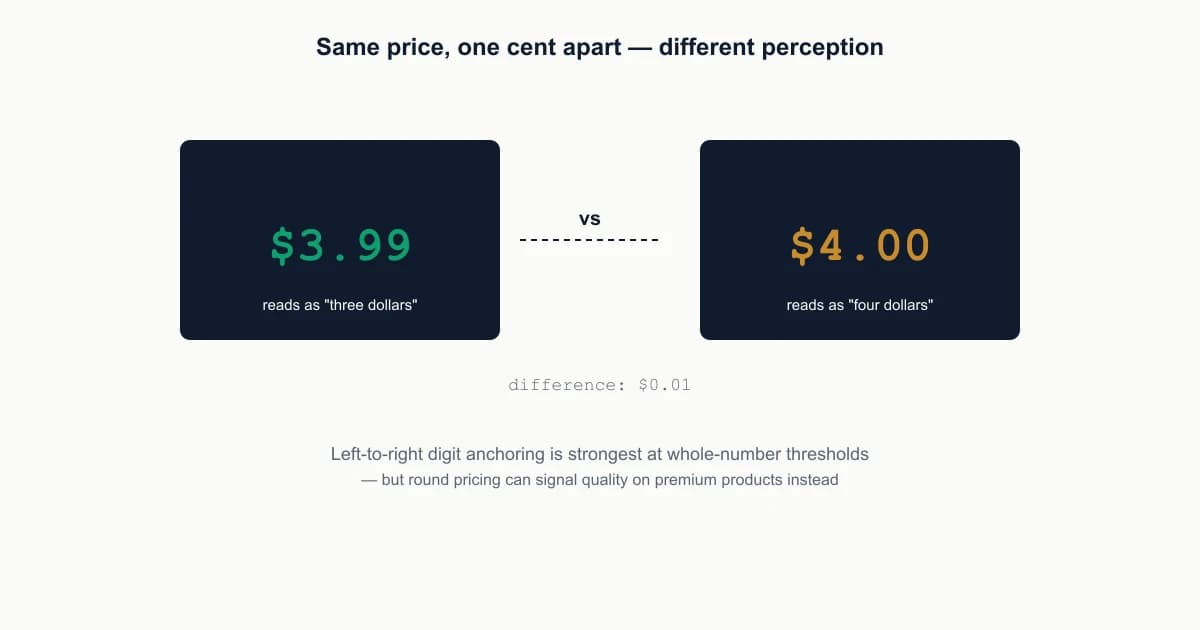
A price ending in .99 is read by most shoppers as meaningfully cheaper than the equivalent price rounded up to the next whole number, even though the actual difference is a single cent. The link between shelf price endings and perceived value is one of the more consistently documented effects in retail pricing psychology, but it isn't a uniform rule that applies with equal strength across every category and every price point.
Why the effect isn't just about the final digit
The common explanation is that shoppers read prices left to right and anchor on the leading digit, so $3.99 registers closer to "three dollars" than to "four dollars" even though it's a cent away from the latter. This effect tends to be strongest at round-number thresholds (just under $1, $5, $10, $20) where crossing the whole-number boundary has a disproportionate psychological impact compared with other less significant number boundaries.
Where the effect weakens or works differently
Premium and higher-end products sometimes perform better with round, whole-number pricing ($20.00 instead of $19.99), since a precisely rounded price can signal quality and confidence rather than looking like a discount-driven price. Categories where shoppers are highly price-conscious and comparison-shopping carefully may respond more to this effect than categories bought more on habit or brand loyalty, where the exact price ending matters less to the purchase decision.
Practical considerations for applying this on the shelf
- Consistency within a category matters for shopper trust — a shelf where some tags use .99 endings and others use round numbers without a clear logic can look inconsistent rather than deliberate, undermining the strategy either way.
- The effect works alongside shelf position, not instead of it — a well-chosen price ending on a poorly positioned facing still underperforms a well-positioned facing, since price perception is only one factor in the full purchase decision.
- Promotional and everyday pricing can use different ending conventions deliberately — a clean round-number promotional price can stand out specifically because it departs from the store's everyday .99 pattern, drawing attention through contrast.
- This is a hypothesis worth testing against your own sales data, not assuming applies uniformly — the well-documented general effect doesn't guarantee it plays out identically in every store, category and shopper base.
This connects to back-to-school aisle planning — the two are usually worth planning together. Worth checking next: new year fitness aisle surge, which covers a closely related part of the same decision. This is closely tied to signage conflicts with shelf, and the two often need to be solved at the same time.
FAQ
Does charm pricing (.99 endings) work for every product category?
It tends to work most reliably for everyday, price-sensitive purchases, and less reliably — sometimes even backward — for premium or luxury-positioned products, where round pricing can better support a quality perception.
Is there a difference between .99 and .95 endings?
Both trade on similar leading-digit psychology, though .99 is more common in many markets and tends to read as slightly more aggressively discount-oriented than .95 in shopper perception, though the difference is subtle and market-dependent.
Should shelf tags ever use round, whole-number pricing?
Yes, particularly for premium products or when a store wants a price to signal quality and confidence rather than looking like a routine discount — the choice should match the product's positioning, not follow one rule across the whole store.


