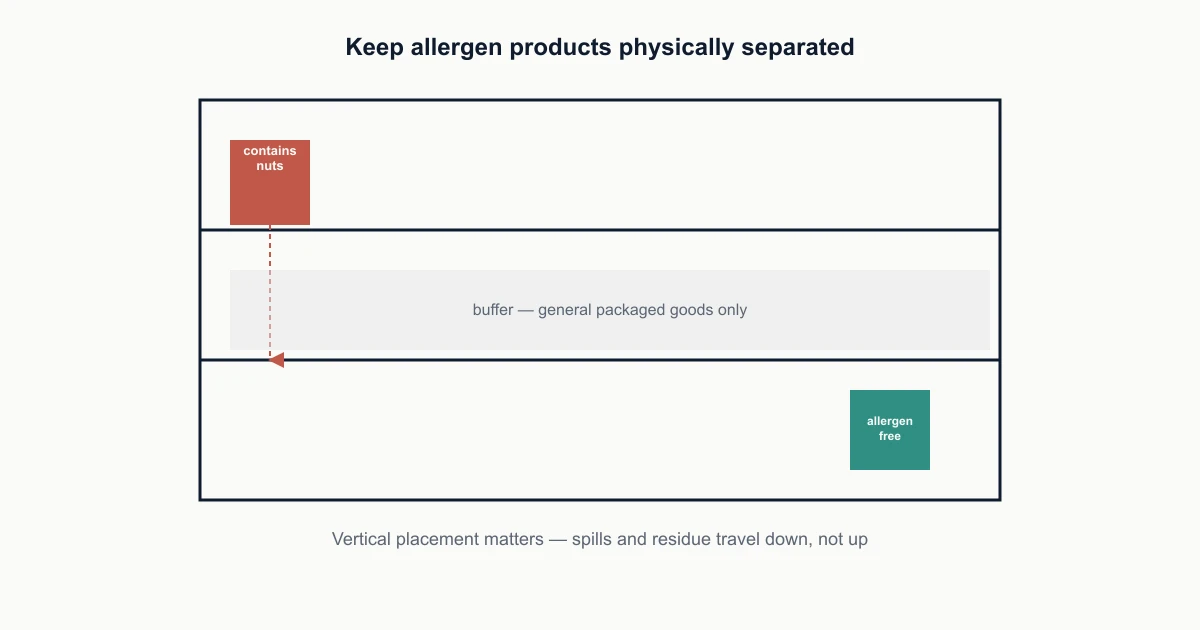
Allergen labeling tells a shopper what's in the package they're holding. It doesn't address a separate, real risk that shelf adjacency can create: cross-contact from spillage, leaking packaging, or a product placed where it can physically touch or drip onto something a shopper with a severe allergy assumes is safe. A planogram that only thinks about labeling and ignores adjacency is only managing half the risk.
Where adjacency-driven allergen risk actually comes from
Open or loosely sealed packaging near allergen-free products. Bulk bins, bakery items, or any product without a fully sealed package carries a real risk of particulate or residue transfer to neighboring shelf positions, independent of what either product's own label says.
Liquid or powder products stored above others on a vertical fixture. A leaking or spilled container on an upper shelf can contaminate whatever sits below it — shelf height sequencing has a safety dimension here that pure sales logic doesn't account for.
Shared equipment or surfaces during restocking. A cart, scoop, or shelf surface used across both allergen-containing and allergen-free products during a reset or restock can transfer trace amounts, even when the products themselves are correctly placed afterward.
Promotional or secondary displays placed without the same scrutiny as the main planogram. A secondary display built quickly for a promotion can inadvertently place an allergen-containing item next to a sensitive category that the main planogram had deliberately kept separated.
Building adjacency safety into the planogram, not just the label
- Treat allergen separation as an adjacency rule with the same weight as a merchandising adjacency rule — explicitly documented on the plan, not left as general common sense for whoever builds the shelf.
- Pay particular attention to vertical placement, not just horizontal neighboring — a spill risk from above is easy to overlook when adjacency is only considered left-to-right.
- Apply the same scrutiny to secondary and promotional displays as the core planogram — an allergen conflict introduced by a one-off display is just as real a risk as one built into the permanent layout.
- Account for open-package categories (bulk, bakery, deli) specifically, since sealed packaged goods carry meaningfully lower cross-contact risk than open or loosely sealed formats.
Worth checking next: pharmacy shelf planogram, which covers a closely related part of the same decision. This is closely tied to bakery shelf planogram, and the two often need to be solved at the same time. If this is a recurring issue in your stores, accessible planogram covers a closely related angle worth checking.
FAQ
Is allergen adjacency a legal requirement or a best practice?
This varies by jurisdiction and by how formal the applicable food safety regulations are — but even where it isn't a strict legal mandate, it's widely treated as a meaningful risk-reduction practice given the severity of allergic reactions.
Does sealed packaging eliminate the need to consider adjacency?
It significantly reduces the risk compared to open or loosely sealed formats, but doesn't eliminate it entirely — damaged or compromised packaging can still create a cross-contact risk even for normally sealed products.
Who should be responsible for enforcing allergen adjacency rules during a reset?
This works best when it's an explicit, trained responsibility — not an assumption that general common sense will catch it — since reset crews under time pressure are focused primarily on completing the category plan, not independently assessing allergen risk.


