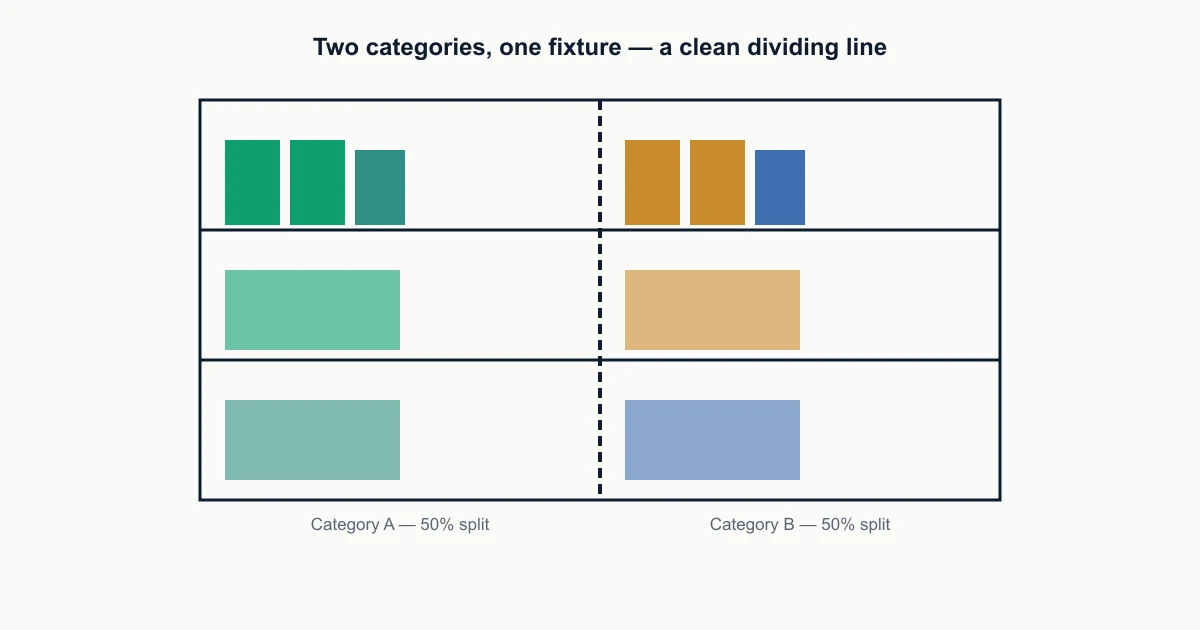
A shelf that looks fully stocked the morning after delivery and noticeably thin by the day before the next one isn't necessarily a planogram problem — it's often a mismatch between how many facings the plan allows and how often the store actually gets resupplied. The plan was built for a snapshot; the real shelf lives through a whole delivery cycle.
The mechanics of the mid-week dip
A planogram specifies facings — how many units sit on the shelf when it's fully stocked. It doesn't, by itself, specify how that stock is expected to drain over the days until the next delivery. If a category sells faster than the facings-to-delivery-cycle ratio supports, the shelf predictably runs thin well before the next truck arrives — and it will do this every single cycle, not as an occasional stockout but as a structural pattern.
This is different from an out-of-stock problem in the usual sense. The product isn't missing from distribution, and the store isn't making an ordering mistake each time — the facings count simply wasn't set with the real replenishment frequency in mind.
Why this gets missed
Facings decisions are usually driven by sales velocity and available space, which is reasonable as far as it goes — but velocity alone doesn't tell you whether the facings will last until the next delivery. A fast-selling item with generous facings can still run thin mid-cycle if the delivery frequency is longer than the facings were sized for, and a slower item with modest facings can look perfectly fine throughout the whole cycle.
Store teams often work around this locally — pulling stock forward to hide gaps, or quietly over-facing a category beyond the plan — which treats the symptom without fixing the underlying mismatch, and creates its own compliance drift.
Fixing the actual mismatch
- Check facings against days of supply, not just velocity. A facings count should comfortably cover the real interval between deliveries for that store, not just look proportionate to how fast the item sells.
- Treat high-mid-week-dip categories as a signal, not routine. If a specific category consistently looks thin by the same day every cycle, that's a facings-vs-delivery mismatch worth fixing on the plan, not something to keep patching manually in-store.
- Consider delivery frequency changes for genuinely undersized categories, where the fixture simply can't hold enough facings to bridge the gap even with ideal counts — sometimes the real fix is a more frequent delivery, not more shelf space.
- Don't confuse this with a reset-cycle gap. A shelf gap right after a reset points to an execution problem during the reset itself; a gap that recurs predictably mid-cycle points to a facings-and-delivery mismatch instead — the fix for each is different.
This connects to how to set replenishment frequency — the two are usually worth planning together. Worth checking next: case pack out, which covers a closely related part of the same decision. This is closely tied to overstocked shelves, and the two often need to be solved at the same time.
FAQ
How do I know if a thin shelf is a mid-cycle dip or an actual stockout?
Check the pattern across several delivery cycles. A predictable dip on roughly the same day each cycle, that recovers after delivery, points to a facings mismatch. An irregular or worsening gap points to a distribution or ordering problem instead.
Should facings be sized for the worst day of the cycle or the average?
Most teams size facings to comfortably cover the period just before the next delivery, which is the worst day of the cycle by definition — sizing to the average leaves the shelf thin for part of every cycle by design.
Can increasing delivery frequency fix this without changing facings?
Yes, where space genuinely can't support more facings, a shorter delivery interval addresses the same gap from the other direction — fewer days for the shelf to drain before it's topped up again.