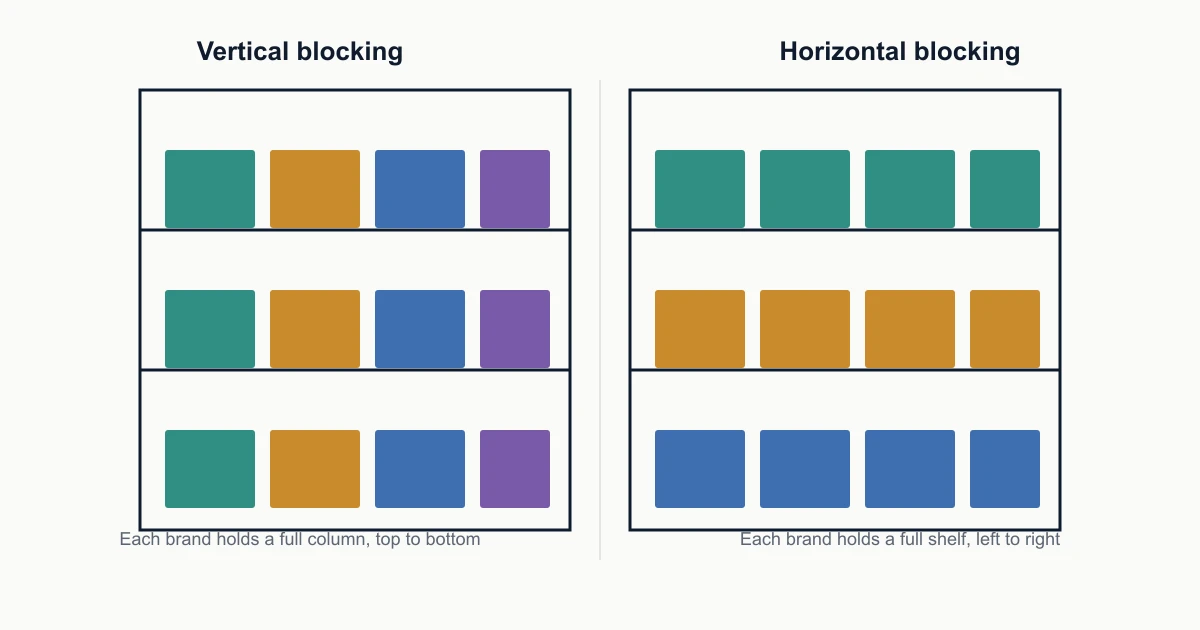
A brand blocking planogram groups all of one brand's products into a single continuous block on the fixture, usually running top to bottom (vertical) or along a shelf (horizontal). It makes the brand easy to spot from the aisle and easy to shop within. It works best when shoppers choose brand first; when they choose type, size or price first, block by that instead.
Brand blocks are one of the oldest tools in visual merchandising, and also one of the most misused. The rest of this guide covers how to decide on a block, how to size and order it, and what to do when the shelf is too small for the plan.
What brand blocking does on the shelf
A block creates a patch of consistent packaging colour, sometimes called a billboard effect. From a few metres away the shopper sees "the red brand" and "the blue brand" before reading a single label. Inside the block, the products are arranged in a predictable order so a loyal shopper finds their flavour or size quickly.
Blocking is a planogram structure, not a placement rule on its own. It sits alongside other decisions: which shelf gets the best sellers, how many facings each product gets, and how the category flows along the aisle.
Vertical vs horizontal blocks
| Vertical block | Horizontal block | |
|---|---|---|
| Layout | One brand runs from top shelf to bottom shelf | One brand fills one or two shelves across the bay |
| What shoppers see | Every brand at eye level as they walk past | Brands compete for the eye-level shelf |
| Works best for | Wide fixtures, several strong brands, long aisles | Narrow bays, short runs, price-tier layouts |
| Risk | Blocks become too narrow on short fixtures | Brands on top and bottom shelves get less attention |
Vertical blocking is usually fairer and easier to shop. Each brand gets a slice of every shelf height, including the eye-level band of roughly 120–160 cm (47–63 in). Shoppers walking along the aisle read brands left to right, then read sizes or flavours up and down inside the block.
Horizontal blocking suits fixtures where brands sit at different price tiers. A common pattern is premium brands at eye level, mainstream brands below and value or private label on the bottom shelf. It also suits short bays where a vertical block would be only one product wide.
Many real planograms combine both: vertical blocks for the main brands, with a horizontal band for small brands or a sub-segment that cuts across brands.
Brand or segment: let the shopper's first choice decide
The most important question is not vertical or horizontal; it is what to block by. The answer comes from the shopper's decision order, often mapped as a consumer decision tree.
- Brand first: shoppers pick their brand, then flavour or size. Common in soft drinks, beer, shampoo and many snacks. Brand blocks work well.
- Segment first: shoppers pick a type (decaf vs regular coffee, sensitive vs whitening toothpaste, gluten-free pasta), then a brand. Block by segment, then by brand inside the segment.
- Size or format first: shoppers pick a pack size (single can, 6-pack, 1.5 L) for an occasion. Block by size or format, then brand.
- Price first: common in value-led stores and private-label-heavy categories. Block by price tier.
A quick test: if a shopper's favourite brand is missing, do they switch brand or switch store? If they switch brand easily, they are probably choosing by segment or price, and a pure brand block will hide what they came for. Loyalty data, basket data and simple shopper interviews in the aisle help answer this.
Size each block from sales, not from habit
Once you know the blocks, give each one space roughly in line with its share of category sales, then adjust for margin, growth plans and any supplier agreements.
Example: a 120 cm (47 in) bay with five shelves sells three brands in a 50/30/20 split. Vertical blocks of about 60 cm, 36 cm and 24 cm match that split. Then check the narrowest block can hold real products: 24 cm fits two 9 cm bottles side by side, with 6 cm left over. If the brand's best seller needs three facings, the block is too narrow and either the split changes or that brand moves to a horizontal band.
Keep block edges straight where you can. A block that zig-zags between shelves loses the billboard effect and is hard for stores to rebuild.
Order products inside the block
Inside each block, use one consistent order across all blocks, so shoppers learn it once:
- Top to bottom: smaller and lighter items up, larger and heavier items down. Multipacks and heavy bottles belong low for safety and handling.
- Left to right: a consistent flavour or variant sequence, for example original, then light, then flavours.
- Eye level: the brand's best sellers and newest launches, since that is where the brand earns most of its sales.
Facings inside the block follow sales and case pack. A slow flavour with one facing still belongs inside the block; moving it elsewhere breaks the pattern shoppers rely on.
Adjacency between blocks
What sits next to each block matters almost as much as the block itself:
- Place similar brands side by side so shoppers can compare.
- Place the private label next to the brand it imitates. Retailers often do this deliberately to invite comparison, as described in Wikipedia's private label article.
- Put the category leader where traffic arrives first, often at the start of the bay in the main walking direction, so it draws shoppers into the category.
- Keep complementary segments together, for example mixers next to soft drinks, rather than scattering them.
When the brand blocking planogram does not fit the shelf
Brand blocks are designed on a standard fixture and often fail on real ones. The common problems:
- Bay too narrow. A vertical block shrinks to one facing wide and disappears. Switch small brands to a horizontal band, or reduce the number of brands blocked on that fixture.
- Shelf heights differ. A tall bottle that fits the bottom shelf in one store does not fit in another. Check clearances for each store variant before you publish.
- Too many SKUs for the block. If a brand has more variants than its space allows, keep the best sellers in the block and delist or move the tail.
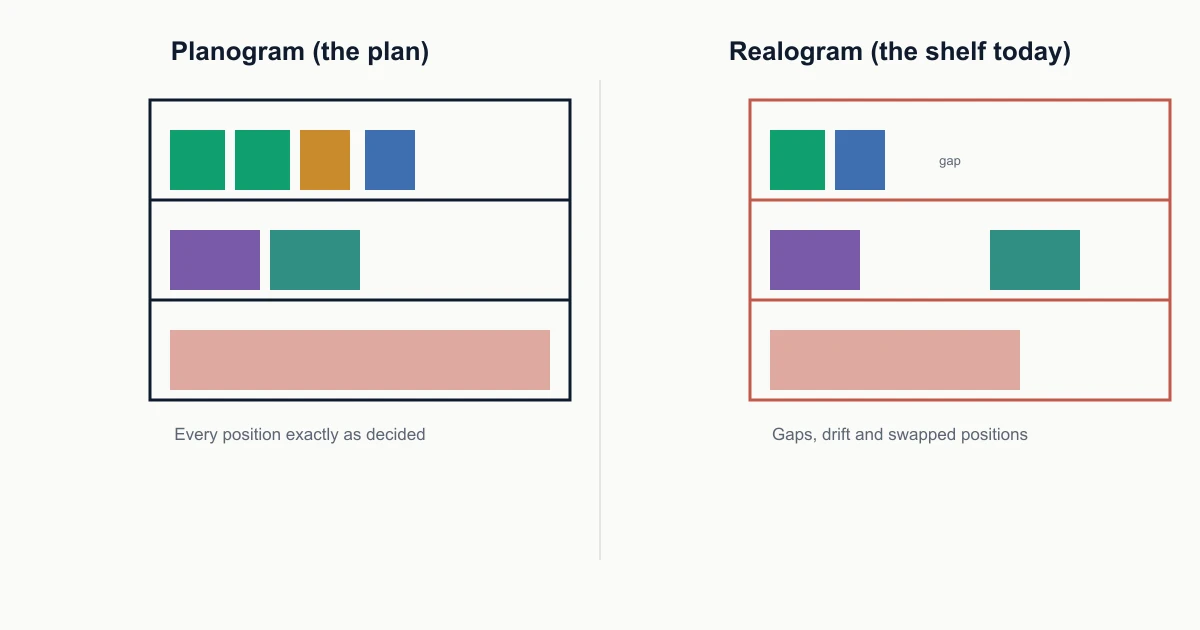
- Stores break blocks to fill gaps. When one product runs out, staff widen the neighbour, and the block edge drifts. Sizing capacity to sales prevents most of this; our guide to planogram compliance covers auditing it.
Store variants are where most of the work is. Rebuilding blocks by hand for every bay width takes hours. Rule-based layout tools handle it automatically; in ShelfPlot, for example, you set brand blocking as a rule, and the auto-layout rebuilds the blocks for each fixture size while respecting real product widths and heights.
Same blocks, different stores
Chains rarely build one planogram per store. They group stores into clusters, such as large, medium and small formats, or by shopper profile, and give each cluster its own version. Brand blocks should survive across clusters even when the space does not.
Keep the block order and adjacencies identical in every cluster, and let only the widths and the number of variants change. A shopper who knows the large store should find the same brands in the same sequence in the small one, just with fewer flavours. If a brand has to drop out of the small format, remove its whole block rather than leaving one stray product somewhere else on the fixture.
Check each cluster separately against its real fixtures: the 90 cm bay, the shorter top shelf, the chiller with a fan cover. A block that works at 120 cm may be one facing wide at 90 cm.
Five rules for a brand blocking planogram
- Block by whatever shoppers choose first; brand blocking is only right when brand comes first.
- Prefer vertical blocks on wide fixtures and horizontal bands on narrow ones or price-tiered categories.
- Size each block from its sales share and check the narrowest block can hold the real products.
- Use one internal order for every block: light items up, heavy down, best sellers at eye level.
- Plan category adjacency deliberately, including private label placement.
For the wider process around these rules, see how to make a planogram.
Block the way your shoppers decide
A brand blocking planogram is a strong tool when shoppers are loyal to brands, and a confusing one when they are not. Decide what to block by from shopper behaviour, size blocks from sales, check every block on the real fixture, and keep the order inside each block consistent across the category.
FAQ
What is brand blocking in retail?
Brand blocking is placing all products from one brand together in a single block on the shelf, so the brand is easy to see and its range is easy to shop.
Is vertical or horizontal blocking better?
Vertical blocking usually suits wide fixtures and strong brands because every brand reaches eye level. Horizontal blocking suits narrow bays and categories arranged by price tier.
What is the difference between brand blocking and category blocking?
Brand blocking groups products by brand. Category or segment blocking groups them by type, such as decaf coffee or sensitive toothpaste, with brands arranged inside each segment.
Where should private label go in a planogram?
Often next to the leading brand it competes with, so shoppers can compare price and pack directly. Some retailers place it on the bottom shelf in price-tiered layouts instead.
How do you decide what to block by?
Use the shopper's decision order: brand, type, size or price. Loyalty data, basket data and short shopper interviews show which choice comes first.