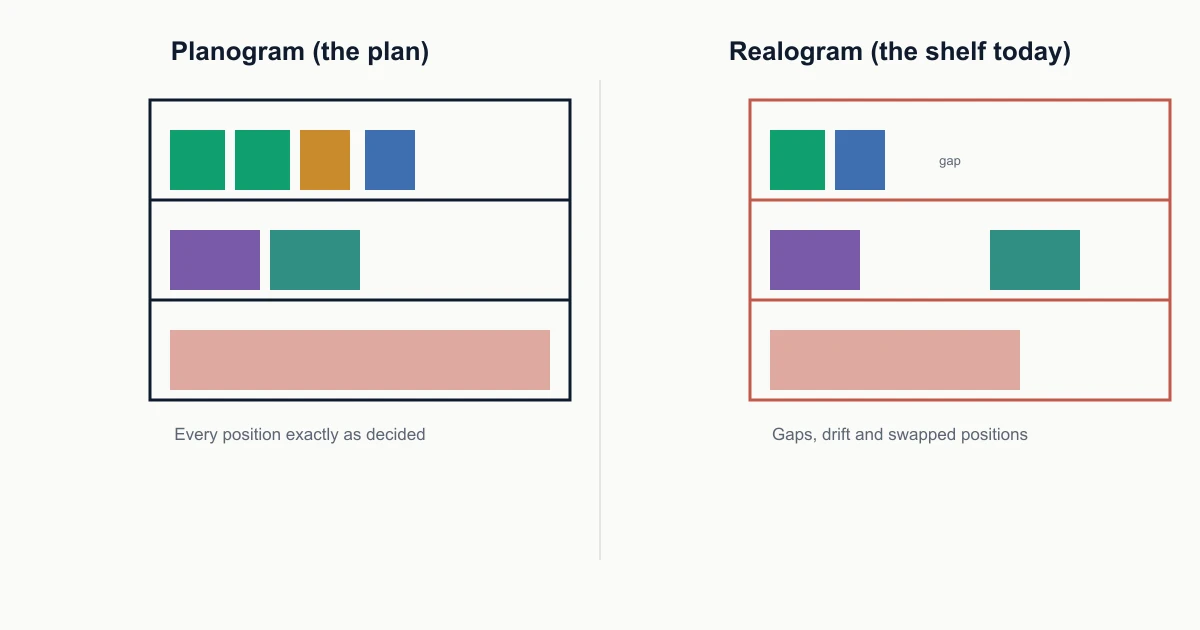
When a category's shelf doesn't match its planogram, the instinct is often to re-plan — adjust facings, rethink sequencing, build a better plan. Most of the time, that's solving the wrong layer of the problem. A well-researched planogram that never gets properly built and maintained in the field will show the exact same symptom — a shelf that doesn't match the plan — as a genuinely bad plan does, and the fix for each is completely different.
How to tell the two apart
Design problems show up as a consistent pattern across every store. If every location struggles with the same category in the same way — a facing count that never quite fits, a sequence that consistently gets rearranged — that consistency points to the plan itself not matching physical or shopper reality, not to a one-off execution failure.
Execution problems show up as inconsistency between stores or over time. If one store nails the category and a nearly identical store down the street doesn't, or if a single store's compliance swings between resets, that variability points to differences in how the plan is being executed — staffing, time pressure, training — not to the plan itself.
Why this distinction gets missed
A low compliance score looks the same regardless of its cause — the shelf doesn't match the plan either way. Without specifically checking whether the gap is consistent (design) or variable (execution), it's easy to default to "fix the plan" as the first response, especially since redesigning feels like a more controllable action than fixing a diffuse, store-by-store execution gap.
Why defaulting to redesign makes things worse
Redesigning a planogram that was never the real problem adds a new plan into the mix without solving what actually caused the gap — and the new plan is just as likely to suffer the same execution failures as the old one, since nothing about staffing, training, or reset process actually changed. Meanwhile, a planogram that genuinely needed revision because it didn't fit real stores can get miscategorized as an execution failure and left unfixed, continuing to generate a gap that's actually built into the plan itself.
Diagnosing before fixing
- Compare compliance across multiple, similar stores for the same category before concluding it's a design or execution issue.
- Check whether the gap recurs the same way after every reset, which points to design, versus appearing inconsistently, which points to execution.
- Talk to the people actually executing the reset before redesigning — they often know directly whether the plan doesn't fit the fixture, or whether time, staffing, or training is the real constraint.
If this is a recurring issue in your stores, planogram vs realogram covers a closely related angle worth checking. See shelf sequencing for a related breakdown that often comes up alongside this. This pairs naturally with planogram implementation guide for store staff, which tackles a closely related piece of the same problem.
FAQ
Can a category have both a design problem and an execution problem at the same time?
Yes — they aren't mutually exclusive, and a thorough diagnosis should check for both rather than stopping once one plausible cause is found.
Is redesigning a planogram ever the right first response to low compliance?
Yes, specifically when the gap is consistent across multiple comparable stores — that pattern is the signal that the plan itself, not execution, is the more likely root cause.
How quickly can execution-related compliance gaps typically be fixed?
Execution fixes — better training, more realistic reset scheduling, clearer escalation processes — can often show measurable improvement faster than a full plan redesign, since they don't require rebuilding and re-rolling out a new planogram.