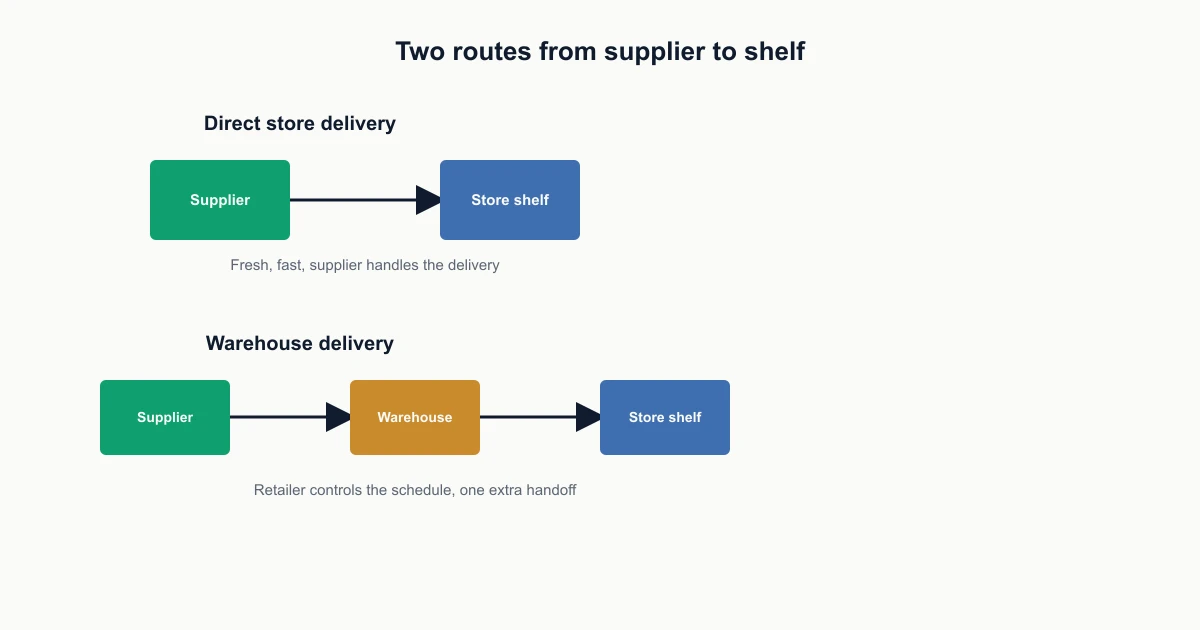
Direct store delivery vs warehouse delivery is about who brings stock to the store. With direct store delivery (DSD), the supplier or its distributor delivers straight to each store, often with its own staff stocking the shelf. With warehouse delivery, products go to the retailer's distribution centre and arrive in the retailer's mixed loads. The choice affects delivery frequency, who merchandises, and how shelves and planograms are kept.
DSD is common for beverages, snacks, bread, dairy and ice cream; most other categories go through warehouses. Wikipedia's direct store delivery article gives background.
Direct store delivery vs warehouse delivery in five points
| Direct store delivery | Warehouse delivery | |
|---|---|---|
| Who delivers | Supplier or distributor | Retailer's distribution network |
| Who stocks the shelf | Often supplier merchandisers | Store staff |
| Frequency | Often several times a week | Set by the retailer's schedule |
| Ordering | Often supplier-managed | Retailer's replenishment system |
| Planogram control | Supplier influence is high | Retailer controls |
What DSD means for the shelf
- Frequent deliveries allow smaller shelf capacity, since the shelf is refilled often.
- Supplier merchandisers can keep their section on plan, but may also push into neighbouring space; see competitor products in my space.
- Branded equipment such as coolers often comes with DSD.
- Ordering is often supplier-run; see vendor managed inventory for shelves.
What warehouse delivery means for the shelf
- Less frequent deliveries need more shelf capacity or backroom stock.
- Store staff do the stocking, so plans must be simple and clear.
- Case packs matter more, because full cases arrive at once; see case pack out.
Planning around both
Size capacity from delivery frequency: DSD items with frequent visits can run tighter; warehouse items need enough days of supply between deliveries. Agree who is responsible for compliance in each section.
Delivery model shapes capacity and control
Direct store delivery vs warehouse delivery decides how often stock arrives and who touches the shelf. Plan capacity and compliance around the model, and both can keep shelves full. Wikipedia's vendor-managed inventory article covers the related ordering arrangement.
FAQ
What is direct store delivery?
A model where the supplier or distributor delivers directly to stores, often stocking the shelves itself.
Which products use direct store delivery?
Commonly beverages, snacks, bread, dairy, ice cream and other fast-moving or fresh items.
Is DSD better than warehouse delivery?
Each suits different products; DSD helps fast, fresh or bulky items, warehouse delivery is efficient for most others.
How does delivery method affect planograms?
It changes how much shelf capacity is needed between deliveries and who maintains compliance.


