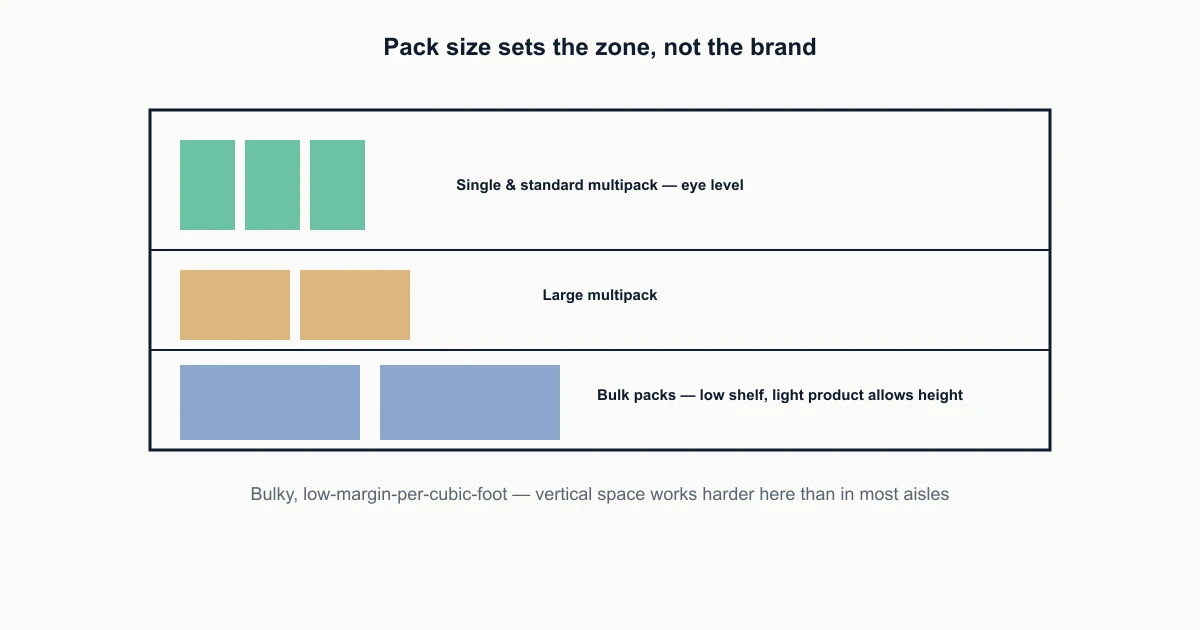
Paper goods — toilet paper, paper towels, facial tissue, napkins — are some of the bulkiest, lowest-margin-per-cubic-foot products in the store, and they're also near-universal purchases. A paper goods aisle planogram has to reconcile those two facts: the category needs a lot of physical space to look adequately stocked, but that space is expensive relative to what the category earns per square foot compared with denser, higher-margin categories nearby.
Why pack size drives the whole layout
Single rolls, standard multipacks and jumbo bulk packs of the same product can differ enormously in footprint, and shoppers buying each size tend to have different habits — bulk buyers are often loyal and buying in advance, while single or small-pack buyers are often restocking mid-week. Planning distinct zones by pack size, rather than mixing sizes within one brand block, makes it easier for each shopper type to find their preferred format without wading through sizes they don't want.
Where vertical space actually helps
Unlike most grocery categories, paper goods genuinely benefit from going higher on the fixture, because the product is light enough that reaching for it from a top shelf isn't the safety or convenience problem it would be with heavier goods. Using vertical space for overstock of bulk packs, with a clearly faced row at a reachable height, lets the category hold more total inventory without expanding its linear footprint.
Planning problems specific to this category
- Plastic wrapping on multipacks tears easily during restocking, leaving loose rolls that look messy and are harder to scan at checkout — training restockers to handle packs by the wrap, not by squeezing the rolls, reduces this.
- Private label and national brand often need very different facing ratios than in other categories, since paper goods is one of the categories where private label frequently captures a large share of volume — check this against your own sales mix rather than defaulting to a standard brand-to-private-label ratio.
- Scent and lotion variants of facial tissue multiply SKU count fast without necessarily multiplying sales — a bounded block for variants keeps the core unscented range from losing facings to a long tail that doesn't earn its space.
- Pallet or pack-down promotions are common in this category and need pre-planned floor space nearby, since a surprise bulk promotion with nowhere to land usually ends up blocking the aisle instead of selling through it.
This connects to coffee and tea aisle planogram — the two are usually worth planning together. Worth checking next: baking aisle planogram, which covers a closely related part of the same decision. This is closely tied to school and office supplies aisle planogram, and the two often need to be solved at the same time.
FAQ
Should bulk packs go on the floor instead of the shelf?
For very large packs, a floor stack or pallet display next to the shelf often works better than forcing them onto a standard shelf, since the shelf's weight rating and depth may not comfortably accommodate the largest formats.
How much shelf space should private label paper goods get?
Enough to reflect its actual sales share, which in this category is often substantial — under-facing a strong private label line here tends to cost more in lost sales than in most other grocery categories.
Does paper goods need frequent resets?
Less often than fast-moving, trend-driven categories — the core range is stable, so resets here are usually driven by pack-size or private-label mix changes rather than a need to refresh for novelty.


