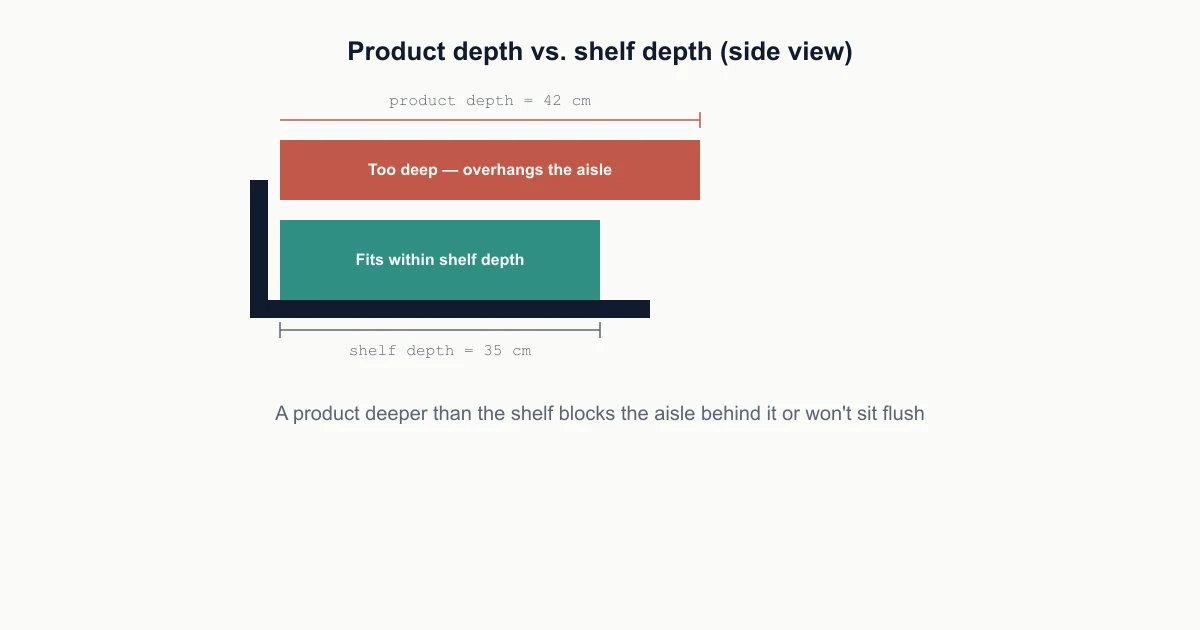
A product too deep for shelf sticks out at the front or will not sit flat because the shelf's usable depth is less than the pack's depth. First measure usable depth (not the nominal shelf size), then try in order: remove anything at the back that is not needed, move the product to a deeper shelf or the base deck, rotate it only if the planogram allows a different face, and finally correct the plan or product data.
Depth problems are less visible than height problems, but they cause overhang, fallen products and hidden labels.
Measure usable depth
Measure from the back of the price-label channel or shelf lip to whatever stops the product at the back: the back panel, a pusher housing, a fence or wiring in a chiller. A shelf sold as 45 cm may offer only 40 cm of usable depth with a pusher fitted.
What to do with a product too deep for shelf
1. Clear the back
Remove unused fences, old dividers or stray stock at the back. Check pushers: if the product does not need one, a shorter model may help.
2. Move to a deeper shelf
Many gondolas mix shelf depths, with the base deck usually deepest. Mixed depths are common on gondola shelving. Large, deep packs often belong there anyway. Keep the product inside its block if possible; swap with a shallower item from the same block.
3. Rotate only if allowed
Turning a box sideways changes width and what shoppers see. Do it only when the planogram shows that orientation, because it also changes facings and capacity.
4. Fix the plan or data
If depth was entered wrongly or the pack changed, the plan fails in every store. Report it with a photo so dimensions are corrected, using the shopper-facing front defined by the GS1 measurement standard.
Depth affects capacity too
Even when a product fits, depth sets units behind each facing: units deep = usable depth ÷ product depth, rounded down. A product moved to a shallower shelf may fit but hold half the stock, causing gaps between refills. Recheck with the shelf capacity calculator. For overhang specifically, see products overhanging shelf edge.
Depth is decided at the back
A product too deep for shelf is usually solved by measuring what is really usable and placing the pack where the depth exists, often low on the fixture. Fix data errors at the source so the next plan fits.
FAQ
How do I know the usable depth of a shelf?
Measure from the front label channel to the first obstacle at the back, such as a back panel or pusher housing.
Can I turn a product sideways if it's too deep?
Only if the planogram allows it; rotation changes width, facings and what shoppers see.
Which shelf is usually deepest?
Often the base deck, the bottom shelf of a gondola.
Does shelf depth affect stock levels?
Yes. Depth sets how many units sit behind each facing, which decides how long the shelf lasts between refills.


