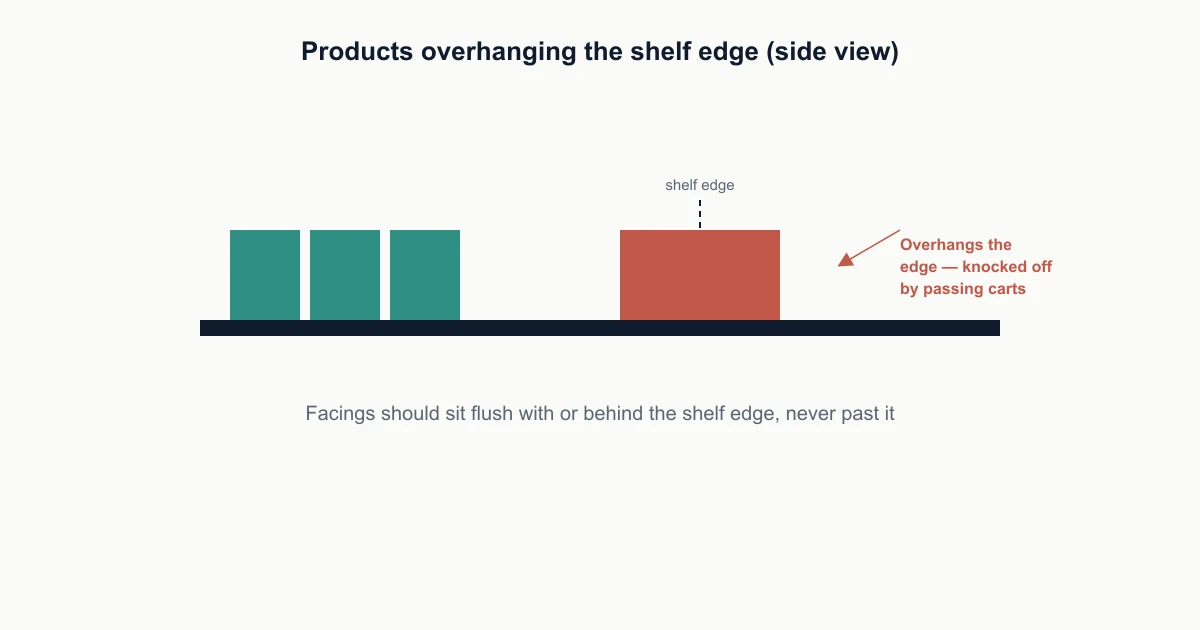
Products overhanging shelf edge happen when more units are placed deep than the shelf can hold, when packs are deeper than the planogram assumed, or when something at the back (a pusher, a tray lip, a back panel) takes depth. Overhang hides price labels, makes shelves look untidy and increases the chance of products being knocked off.
The quick fix is to remove the extra unit. The lasting fix is to correct the plan's units deep or the product data.
Why overhang is a problem
- Labels hidden. Overhanging packs cover the price strip, so shoppers cannot see prices and staff mis-scan. The reverse problem, a price strip blocking products, hides short packs.
- Safety. Products sticking out get knocked by trolleys and shoppers, especially at low shelves.
- Appearance. A ragged front edge makes the whole fixture look messy.
- Damage. Bags and boxes on the edge get crushed.
Four reasons for products overhanging shelf edge
1. Too many units deep
The plan or the staff put one more unit behind each facing than fits. Fix: units deep = shelf depth ÷ product depth, rounded down. A 45 cm shelf holds four 11 cm deep boxes, not five.
2. Product deeper than planned
Pack changes or wrong data mean the real product is deeper than the plan's figure. Fix: re-measure from the default front and correct the data, following the GS1 measurement standard.
3. Something at the back
Pusher springs, tray lips, back panels or wiring in chillers take depth. Fix: measure usable depth, not nominal depth.
4. Trays and shippers
Shelf-ready trays add a few centimetres. Fix: plan with tray dimensions when products stay in them.
Overhang on purpose?
Some retailers allow slight overhang on specific items, such as hanging tabs or blister headers, by agreement. Write it on the planogram if so; otherwise the rule is that products stop at the shelf edge or label strip.
Prevent it in the plan
When building a plan, check depth for every shelf, including the base deck, and use the shelf capacity calculator to set units deep. If a product genuinely needs more depth, move it to a deeper shelf rather than letting it stick out. For more on depth problems, see product too deep for shelf.
Stop at the edge
Products overhanging shelf edge are a capacity error made visible. Remove the extra units today, then fix the units deep in the plan or the product data, and the shelf front will stay straight and safe. Stacked and stored goods should always stay stable, a principle set out in OSHA's rule on material storage.
FAQ
Why do products stick out past the shelf edge?
Too many units have been placed deep, the product is deeper than planned, or something at the back of the shelf takes depth.
Is it safe for products to overhang shelves?
Generally not. Overhanging products are easier to knock off and can hide price labels.
How do you calculate how many products fit deep?
Divide usable shelf depth by product depth and round down.
What should I do if a product is too deep for every shelf?
Move it to the deepest shelf, often the base deck, or ask for the plan or fixture to be changed.


