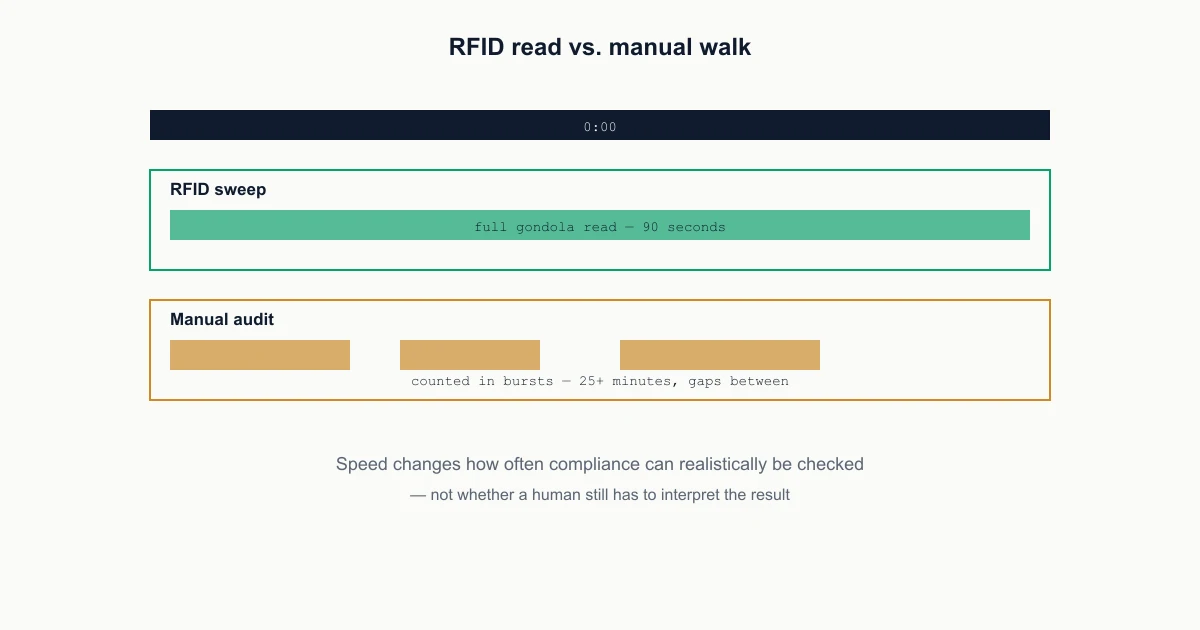
RFID shelf tracking reads tagged inventory continuously, rather than at the moment someone walks the aisle with a checklist or a camera. That difference — continuous versus point-in-time — is what it's genuinely good at, and it's worth understanding specifically rather than treating RFID as a general upgrade to any audit method.
What RFID actually catches
Stock movement between audit cycles. A manual or photo audit only knows the state of the shelf at the moment it was captured. RFID, where deployed, can show inventory levels changing continuously — catching a stockout that happens and even partially resolves between two scheduled audits, which neither manual nor photo methods can see.
Backroom-to-shelf movement gaps. Because RFID can track tagged items through the supply chain, not just on the shelf, it can help identify product that's technically in the store (counted as "in stock" in the backroom) but never actually made it to the sales floor — a gap that on-shelf-only audit methods can't distinguish from a genuine stockout.
Faster detection of a specific kind of shrink. Items disappearing from a tagged inventory flow in ways that don't match expected sales patterns can be flagged more quickly than waiting for a scheduled physical count to notice the discrepancy.
What RFID doesn't automatically solve
It doesn't verify correct placement or facing compliance. RFID tells you a tagged item is present somewhere in range of a reader — it generally doesn't confirm the item is in the correct shelf position, correctly faced, or part of a compliant planogram layout the way a visual audit does.
It depends on tagging compliance throughout the supply chain. RFID's accuracy is only as good as how consistently every unit is actually tagged — a category with inconsistent tagging from suppliers undermines the whole system's reliability for that category.
It has real deployment costs. Tag costs, reader infrastructure, and system integration represent a meaningful investment, which is why RFID deployment tends to concentrate on higher-value or higher-shrink categories rather than blanket store-wide coverage.
Choosing where RFID is worth it
- Prioritize high-value or high-shrink categories where the stockout and shrink detection benefits justify the tagging and infrastructure cost.
- Pair RFID with a visual audit method for placement and facing compliance, rather than treating it as a full replacement — the two catch genuinely different kinds of problems.
- Confirm supplier tagging compliance before relying on RFID data, since inconsistent tagging upstream undermines the accuracy of everything downstream.
If this is a recurring issue in your stores, product recall removal covers a closely related angle worth checking. See reset crew safety incidents for a related breakdown that often comes up alongside this. This pairs naturally with digital price tags vs printed shelf tags, which tackles a closely related piece of the same problem.
FAQ
Does RFID replace the need for planogram compliance audits?
No — RFID is strong on presence and movement detection but weak on placement and sequencing verification, which still requires a visual audit method like photo or manual checks.
Is RFID cost-effective for low-value, high-volume categories?
Less often — the per-unit tagging cost is harder to justify for low-margin, high-volume items than for higher-value categories where shrink and stockout detection have a clearer financial payoff.
How does RFID interact with BOPIS inventory accuracy?
RFID can meaningfully improve real-time store inventory visibility, which is one of the central constraints on reliable buy-online-pickup-in-store fulfillment — though it doesn't eliminate the need for accurate system-to-shelf reconciliation.


