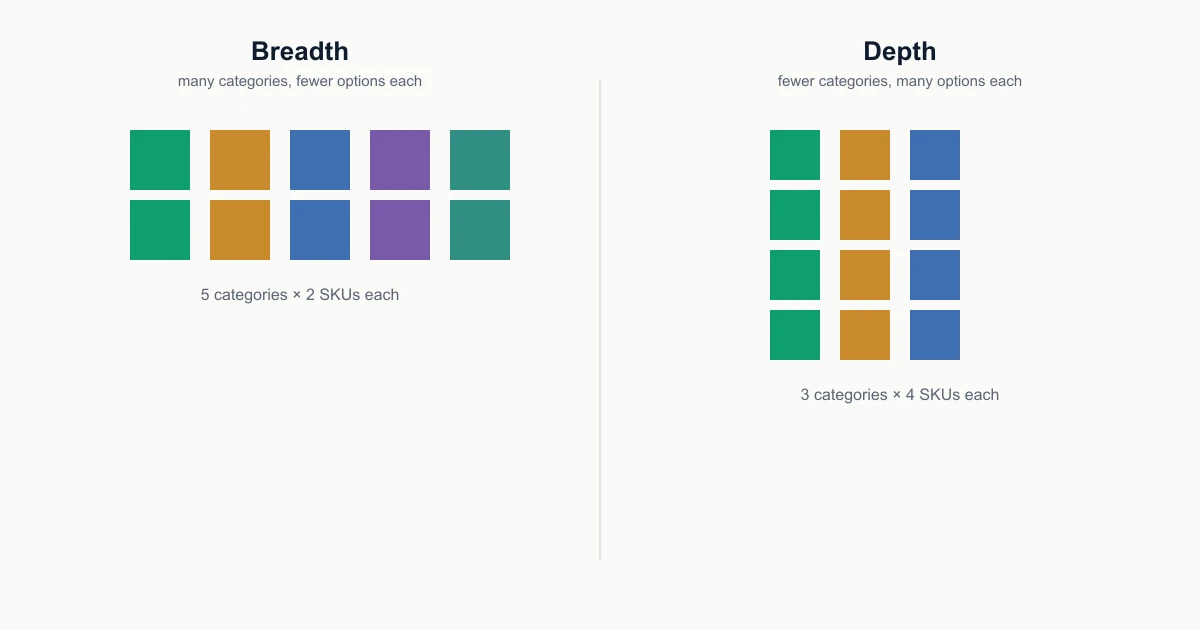
Assortment depth vs breadth describes two directions of range: breadth is how many different categories or product types a store carries; depth is how many options (brands, sizes, flavours) it offers within each. A convenience store is broad and shallow: many categories, few options each. A specialist store is narrow and deep. Shelf space forces a trade-off between the two.
Breadth and depth compared
| Breadth | Depth | |
|---|---|---|
| Measures | Number of categories or types | Options within a category |
| Wins | One-stop convenience | Choice for specific needs |
| Shelf effect | More categories, less space each | More SKUs, fewer facings each |
| Typical format | Convenience, discount | Specialist, large supermarket |
How to balance assortment depth vs breadth
- Start from the store's role. Top-up stores need breadth; destination stores need depth in key categories.
- Give depth where shoppers choose carefully. Wine, coffee, personal care often need options; staples like sugar rarely do.
- Keep breadth where shoppers expect to find something. Missing a whole category sends them elsewhere.
- Check facings. Depth that leaves best sellers on one facing is too much; see long tail products shelf space.
Example on one bay
A 120 cm snack bay could hold 30 SKUs with one or two facings each (deep) or 15 SKUs with three or four facings (shallow but well stocked). For a convenience store, the second usually sells more because best sellers stay in stock. For a large supermarket, more depth may fit across several bays.
Reviewing the balance
Use sales and availability by store format. If gaps on best sellers are frequent, reduce depth; if shoppers ask for missing categories, add breadth. Assortment optimization basics covers the full review process.
Breadth to be useful, depth where it matters
Assortment depth vs breadth isn't a single choice for the whole store: be broad enough that shoppers find what they expect, and deep only in categories where choice drives sales. Shelf space and availability decide where the line falls. Wikipedia's category management article and its planogram entry give context.
FAQ
What is assortment breadth?
The number of different categories or product types a store carries.
What is assortment depth?
The number of options, such as brands, sizes or flavours, within each category.
Which is better, depth or breadth?
It depends on the store's role: convenience stores favour breadth, specialist stores favour depth.
How does assortment depth affect shelf space?
More options mean fewer facings each, which can cause gaps on best sellers.


