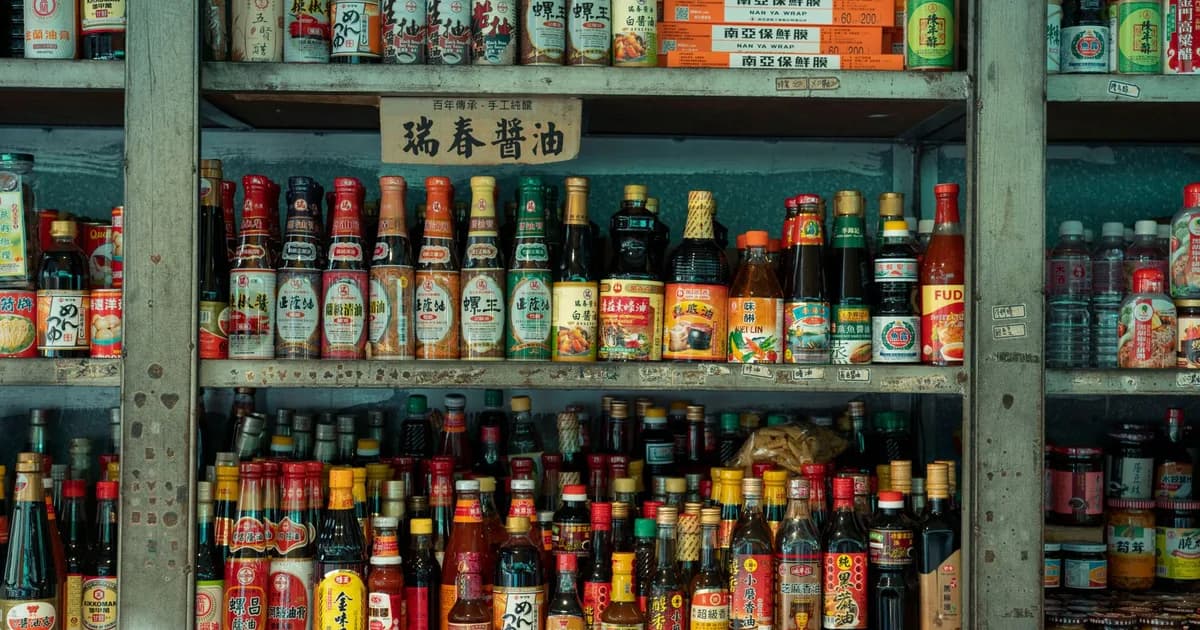
Most dry grocery aisles have a natural anchor — pasta anchors the sauce aisle, cereal anchors breakfast. Condiments don't really have one. Ketchup, mustard, mayonnaise and hot sauce are each sizeable in their own right, and then there's a long tail of specialty sauces, dressings and spreads that don't cleanly belong to any of them. A condiments aisle planogram has to impose structure on a category that doesn't naturally organize itself.
Picking an organizing principle and sticking to it
The two workable approaches are organizing by product type (all ketchups together, all mustards together, regardless of brand) or by use occasion (grilling condiments together, sandwich spreads together, salad dressings together). Product-type blocking is easier to maintain and matches how most shoppers actually search ("where's the mustard"), while occasion blocking can lift basket size around specific meal moments but needs more active curation to avoid drifting into a messy junk-drawer section.
Bottle shape is doing more work than it looks like
Condiment packaging varies more in shape than almost any other grocery category — squeeze bottles, glass jars, squat tubs, narrow hot sauce bottles. A planogram built around a single generic shelf depth and facing width will underperform here; the shelf needs to flex section by section to match what's actually sitting on it, or you end up with wasted depth behind short bottles and crowded, leaning stock behind tall ones.
Keeping the long tail from taking over
- Specialty and ethnic condiments deserve a defined, bounded section rather than being allowed to expand facing by facing into the mainstream block — a bounded section protects the core range's space while still giving the specialty range room to grow within its lane.
- Squeeze bottles stored upside down for "ready to pour" convenience need extra vertical clearance that a standard shelf height calculated from an upright bottle won't account for.
- Glass jars carry real breakage risk on lower shelves near the floor, where a dropped case does more damage — weighing that risk against the lower shelf's lower visibility is worth doing explicitly rather than defaulting glass to the bottom.
- New condiment launches are frequent and easy to lose track of in a category this fragmented — a small rotating trial block keeps new entries from either crowding out the core range or never getting a fair shelf test.
Worth checking next: coffee and tea aisle planogram, which covers a closely related part of the same decision. This is closely tied to candy aisle planogram, and the two often need to be solved at the same time. If this is a recurring issue in your stores, vitamins and supplements aisle planogram covers a closely related angle worth checking.
FAQ
Should hot sauce get its own section or stay inside condiments generally?
If hot sauce sales support enough facings to form a visually coherent block, a labeled sub-section works better than scattering it — hot sauce shoppers are often specifically seeking variety and heat level, which rewards a dedicated, browsable block.
How do you decide how much space mayonnaise gets versus ketchup?
By actual sales velocity and margin per facing in your own data, not by assumption — the two categories look similar in prominence nationally but can skew very differently store to store depending on local cuisine and demographics.
What's the biggest risk in a condiments aisle that's been running too long without a reset?
Slow creep from the long tail. Specialty SKUs added one at a time without ever being removed gradually squeeze the core, high-volume products into fewer facings than their sales justify.


