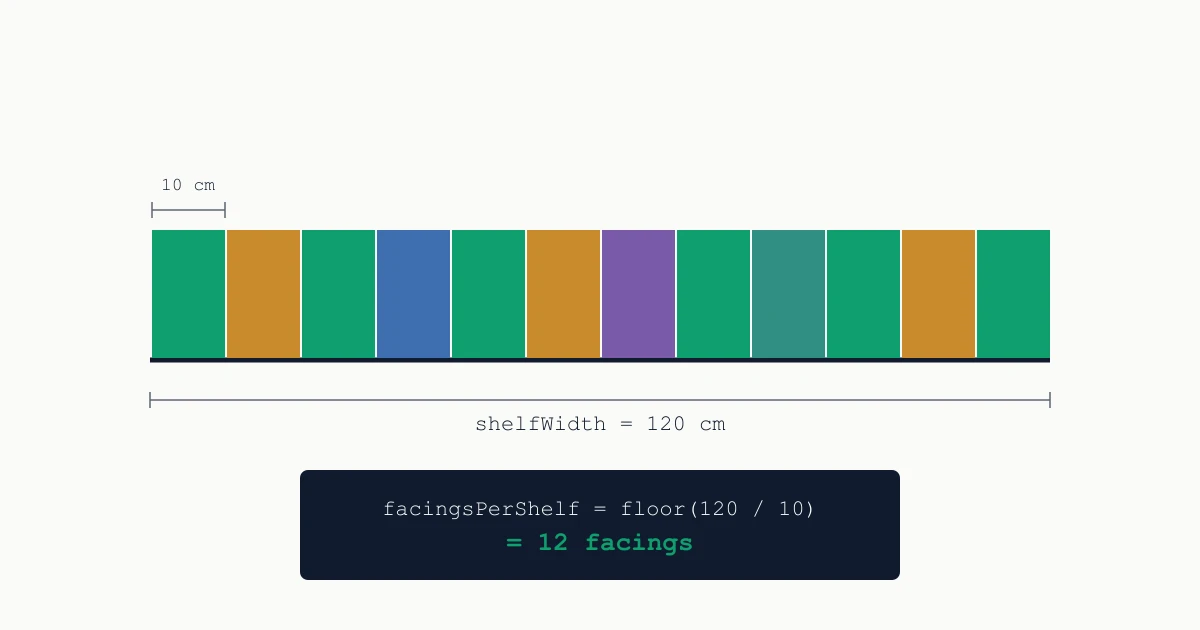
How to calculate shelf capacity in units: multiply facings across × units deep × units high. Facings across = shelf width ÷ product width, units deep = shelf depth ÷ product depth, units high = usable clearance ÷ product height, each rounded down. Then confirm the total weight stays under the shelf's rated load.
For a 120 cm shelf, 50 cm deep with 35 cm clearance, holding 330 ml cans (6.6 × 11.5 × 6.6 cm), that is 18 × 7 × 2 = 252 cans. The rest of this guide explains each number, the traps that shrink it, and the weight check that retail planograms often forget.
Measure the usable shelf, not the nominal size
A shelf sold as "120 cm" rarely gives you 120 cm of product space. Before you calculate, measure:
- Width between uprights or end dividers.
- Depth from the front lip or price strip to the back, minus anything at the rear such as a back panel lip or wiring in a chiller.
- Shelf clearance from the shelf surface to the underside of the shelf above. On the top shelf, use the height you can reach and see, not the fixture top.
Leave 1–2 cm (about ½–¾ in) of finger space above the tallest product so staff can pull items out and shoppers can lift them. The examples below subtract 2 cm.
| Dimension | Metric | Imperial |
|---|---|---|
| Width | 120 cm | 47.2 in |
| Depth | 50 cm | 19.7 in |
| Clearance | 35 cm | 13.8 in |
Use product dimensions from the shopper-facing front
Width, height and depth must be measured from the face the shopper sees. The GS1 Package and Product Measurement Standard calls this the default front, and supplier data usually follows it. Swapping width and depth on a rectangular pack is the most common cause of a wrong capacity figure.
Facings across: the width calculation
Facings = floor((shelf width + gap) ÷ (product width + gap))
The gap is the space you leave between facings. With no gap, 120 ÷ 6.6 = 18.18, so 18 facings fit, using 118.8 cm. With a 0.5 cm gap, (120 + 0.5) ÷ (6.6 + 0.5) = 16.97, so only 16 facings fit. Half a centimetre per product cost two facings, which is why the gap must be agreed before anyone counts.
When several products share a shelf, add up each product's width × facings plus gaps and make sure the total does not pass the usable width. The shelf capacity calculator does both checks instantly.
Units deep: the depth calculation
Units deep = floor(shelf depth ÷ product depth)
For the can, 50 ÷ 6.6 = 7.58, so 7 deep. Two traps:
- Pushers and dividers take depth. A pusher spring housing might take 3–5 cm at the back; measure your own.
- Trays and shippers add depth and width. If products sit in a tray, use the tray dimensions, not the product's.
On peg hooks the same depth logic decides units per hook; the pegboard planogram guide covers hook spacing too.
Units high: stacking and clearance
Units high = floor((clearance − finger space) ÷ product height)
For the can: (35 − 2) ÷ 11.5 = 2.87, so 2 high, but only if the product can be stacked safely. Cans in shrink-wrapped trays stack well; loose bottles, bags and pouches usually do not. Count stackable items only. A 1.5 L bottle 32 cm tall fits under 33 cm of usable clearance once, so it is 1 high.
Total units per shelf
Shelf capacity = facings × units deep × units high
| Product | Facings | Deep | High | Capacity |
|---|---|---|---|---|
| 330 ml can, 6.6 × 11.5 × 6.6 cm | 18 | 7 | 2 | 252 |
| 1.5 L bottle, 9 × 32 × 9 cm | 13 | 5 | 1 | 65 |
| 150 g snack bag, 18 × 25 × 7 cm | 6 | 7 | 1 | 42 |
Multiply by the number of shelves for a bay, but check each shelf separately. Clearances often differ between top, middle and bottom shelves.
How to calculate shelf capacity by weight
Unit capacity tells you what fits; shelf weight capacity tells you what it can safely hold. Warehouse-shelving guides focus on this, and it matters in retail too, especially for beverages, detergents and pet food.
- Find the manufacturer's load rating for the shelf, or for each bracket if the shelf hangs on brackets. Look for a label on the shelf, the original specification or ask the manufacturer.
- Calculate the product load: units × weight per unit. 252 cans at roughly 0.35 kg each come to about 88 kg (194 lb).
- Compare the two and keep a margin below the rating. Old, modified or damaged shelving should be inspected before it is loaded heavily.
If the product load is near the limit, use fewer units deep, move heavy items to the bottom shelf (which usually rests closer to the base) or upgrade the shelf. Stacked goods must also stay stable; OSHA's general rule on material storage requires stored material to be stacked so it cannot slide or collapse.
Check capacity against sales before you lock the plan
A shelf can be physically full and still too small. Compare capacity with demand:
Days of supply = shelf capacity ÷ average daily sales
If the can sells 36 a day, 252 units last 7 days. If the store restocks every 3 days, that is comfortable. If a product's capacity is less than its case pack, staff cannot put a full case on the shelf, so they leave the rest in the backroom or squeeze it into a neighbour's space. A useful rule is capacity ≥ one case pack + expected sales between refills. Our guide on product facings covers how to allocate width when capacity and demand disagree.
Round down and count only usable space
Knowing how to calculate shelf capacity comes down to rounding down at every step and measuring what is really usable. A 0.5 cm gap, a pusher at the back or a missing 2 cm of finger space can remove 10–20% of capacity from a plan that looked fine on paper. Measure the real shelf, use shopper-facing product dimensions, count only stackable items as stacked, and check weight before you load heavy categories.
FAQ
What is the shelf capacity formula?
Shelf capacity in units = facings across × units deep × units high, where each part is the shelf dimension divided by the product dimension, rounded down.
How do I calculate how many products fit on a shelf?
Divide the usable shelf width by the product width (plus any gap) and round down for facings, then repeat with depth and height. Multiply the three results.
How much weight can a retail shelf hold?
It depends on the shelf and fixture. Check the manufacturer's rated load on the shelf label or specification and keep the product weight comfortably below it.
Should I leave space above products on a shelf?
Yes. Around 1–2 cm (½–¾ in) of clearance above the tallest product makes it easier for staff to restock and for shoppers to lift products off the shelf.


