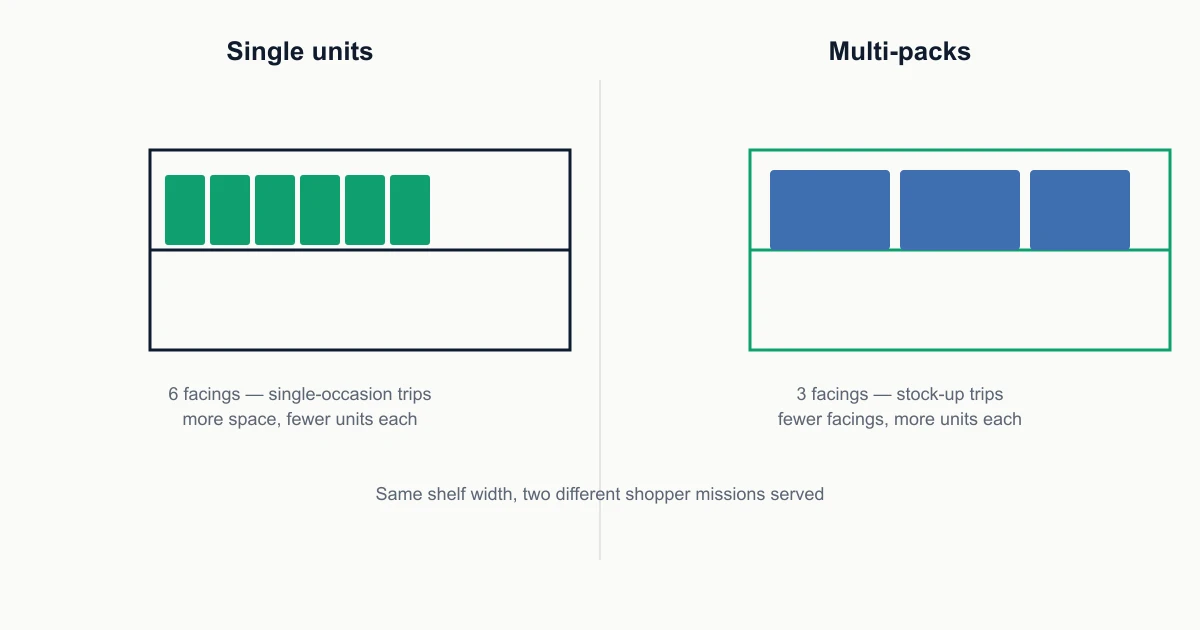
When the same product is available as single units and as a multi-pack, a planogram has to decide how much shelf space goes to each — and that decision affects more than just facing counts. It shapes which shoppers the shelf is actually serving, and how efficiently the space is used.
What each format trades off
Single units take more shelf space per total unit sold. A facing of single-unit product covers fewer total units of product than the same facing width in multi-pack form, since each individual-unit facing is one sale's worth of product, while a multi-pack facing is several.
Multi-packs move more volume per facing, but serve a narrower shopper need. A shopper buying for a single occasion — a quick drink, a single snack — isn't well served by a multi-pack-only shelf, even though the multi-pack format is more space-efficient for the retailer.
Single units support impulse and trial; multi-packs support stock-up trips. These are genuinely different shopping missions, and a category that only plans for one format is implicitly deciding which mission it's optimizing for, whether or not that's a deliberate choice.
Price-per-unit perception differs between formats. Multi-packs are usually priced to look like better value per unit, which can shift purchase behavior toward bulk buying — a dynamic worth planning for deliberately, not as an accidental side effect of facing allocation.
How to actually decide the split
- Check what mission the store's shopper is actually on. A convenience-format store serving mostly single-occasion trips has a different ideal split than a larger-format store serving weekly stock-up shopping.
- Look at sell-through data for each format separately, not combined — a strong combined sales number can mask one format meaningfully underperforming the other.
- Consider category role, not just velocity. A category meant to drive trial of a new flavor or brand may benefit from single-unit space even if multi-pack moves more total volume, because trial happens at the single-unit level.
- Don't assume the split should be static — a category's ideal single-unit-to-multi-pack ratio can shift seasonally (single units for warm-weather impulse, multi-packs for holiday stock-up) and should be revisited accordingly.
This connects to personal care planogram — the two are usually worth planning together. Worth checking next: seasonal demand swings, which covers a closely related part of the same decision. This is closely tied to two categories sharing one fixture, and the two often need to be solved at the same time.
FAQ
Is there a standard ratio of single-unit to multi-pack facings?
No — the right ratio depends heavily on store format, shopper mission, and category, which is why it needs to be decided from that specific store's and category's data rather than applied as a universal rule.
Should multi-packs always get prime eye-level space since they move more volume?
Not automatically — eye-level space is also where impulse and trial purchasing happens most, so a category relying on single-unit impulse sales may do better with single units at eye level and multi-packs positioned for a deliberate stock-up decision instead.
Does this decision affect out-of-stock risk differently for each format?
Yes — a multi-pack facing holds more total units before running out, which can make it more resilient to delivery-cycle gaps than an equivalent single-unit facing with the same shelf width, something worth factoring into the facings-vs-delivery-cycle math separately for each format.


