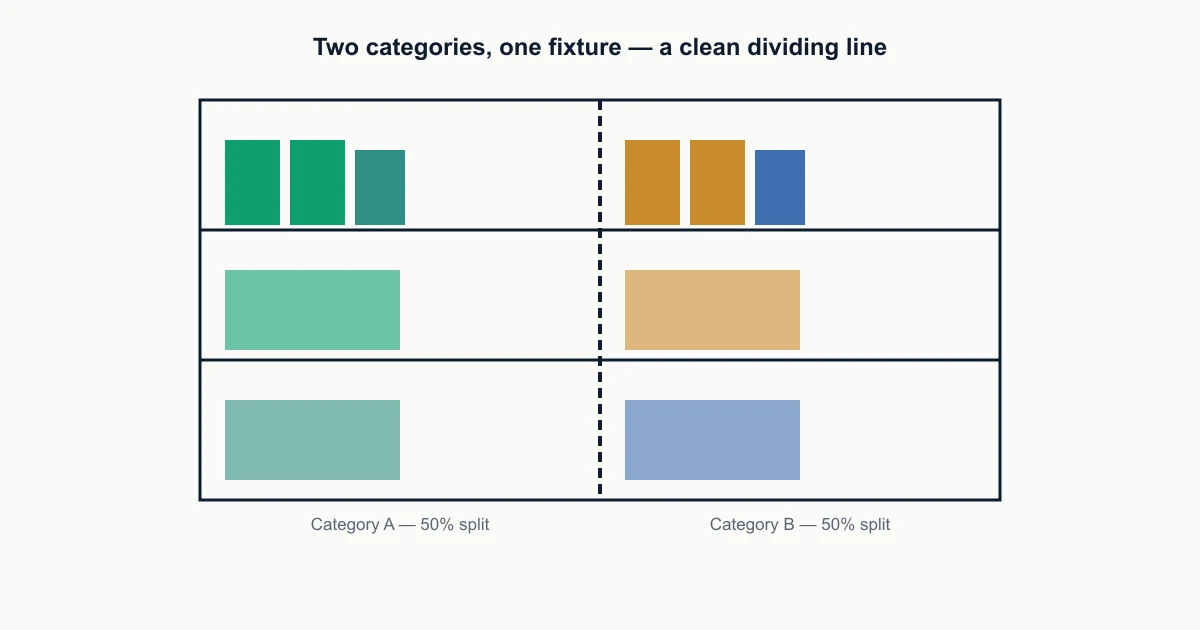
Not every fixture holds a single category. Smaller stores, tight footprints, or naturally related categories often share one gondola or bay between two distinct categories — and when that split isn't planned deliberately, it tends to default to whichever category pushed hardest for space, rather than what actually serves the shopper or the business best.
Why a shared fixture needs its own explicit logic
A single-category fixture inherits its space allocation from that category's own sales and strategic priority. A shared fixture has no such built-in answer — the split between the two categories is a separate decision that has to be made on purpose, using a consistent method, or it drifts toward whichever category's stakeholders are more assertive or whichever reset happens most recently.
How to approach the split
Use the same space-to-sales logic you'd apply within a single category, across the two. Comparing each category's sales and margin contribution relative to the space it currently holds gives an objective starting point for the split, rather than an arbitrary even division or a default to whichever category "was there first."
Respect a clean dividing line, not an interleaved mess. Shoppers navigate a shared fixture more easily when the two categories occupy clearly separated zones — interleaving them to maximize space efficiency usually confuses more than it helps, even if it technically uses the fixture more fully.
Plan for seasonal or promotional space-sharing shifts explicitly, the same way a single category would plan for seasonal facing changes — if one category's space needs vary by season, the shared fixture needs a defined process for borrowing and returning that space, not an ad hoc negotiation each time.
Revisit the split at the same cadence as a normal category review, not less often just because it's a shared, secondary arrangement — a shared fixture's allocation can go stale exactly the way a single category's facings can.
What tends to go wrong without a deliberate split
- One category's space creeping into the other's, a bit at a time, with no explicit decision behind each incremental change.
- A visually confusing fixture where the dividing line between categories isn't clear to a shopper trying to navigate it.
- No consistent process for how temporary space needs (a promotion, a seasonal peak) are handled, leading to a different ad hoc negotiation every time.
This overlaps with category split across two fixtures, which is worth checking if that's also part of your situation. A closely related question is bulk bin merchandising, which tends to come up around the same time. This connects to personal care planogram — the two are usually worth planning together.
FAQ
How often should a shared fixture's category split be reviewed?
Treating it on the same schedule as a normal category review — rather than a separate, less frequent cadence — keeps the split current with each category's actual performance rather than letting it fossilize at whatever arrangement was decided once.
Should the two categories on a shared fixture always get equal space?
No — an even split is a reasonable starting assumption in the absence of other data, but relative sales and margin contribution is a more defensible basis once performance data exists for both categories in that specific space.
Is it better to interleave two related categories or keep them in clearly separate zones?
Clearly separated zones are generally easier for shoppers to navigate, even when the two categories are closely related — interleaving can work for genuinely complementary items meant to be compared side by side, but it's the exception, not the default approach.


