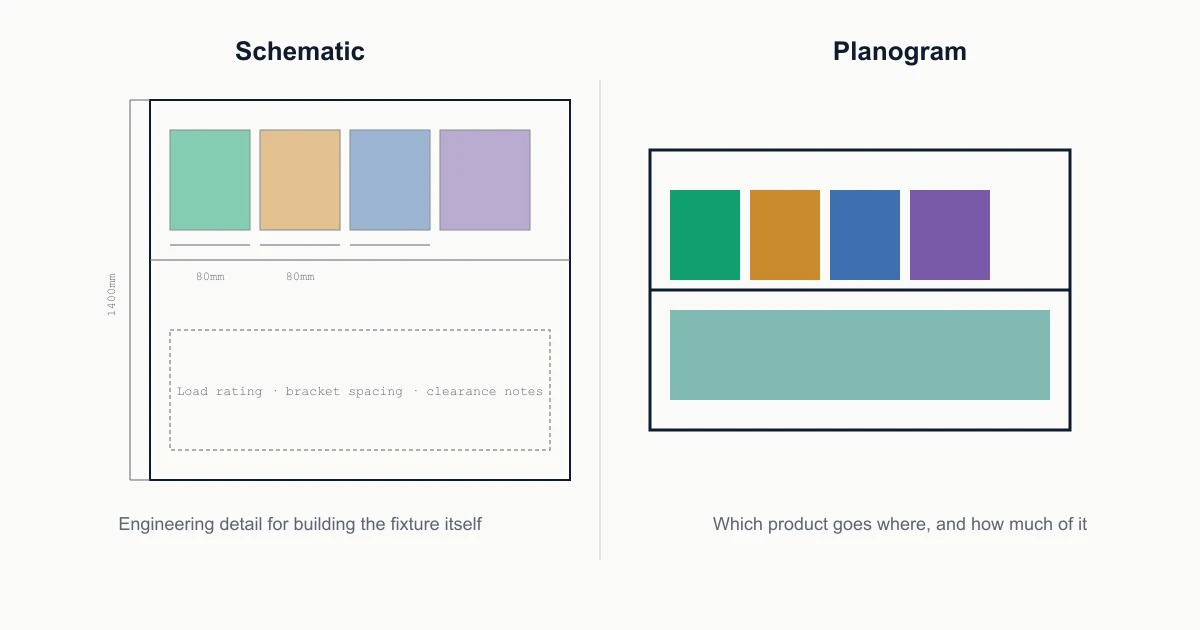
Planogram vs schematic is mostly a question of who is speaking. At many retailers, "schematic" is simply another word for planogram: the to-scale plan of products on a fixture. Elsewhere, a schematic means a simplified version of the planogram, usually a line drawing with boxes and codes instead of product images, made for fast execution in store.
So the safe answer is: check the house definition. The two words describe the same decision (what goes where), but sometimes in different formats.
Planogram vs schematic when the words mean the same plan
Some chains and suppliers use "schematic", "planogram", "POG" and "plan" interchangeably, and US chains add "mod" to the list (planogram vs modular). In that case:
- the schematic shows the fixture, shelves, products, facings and codes
- it is issued per store or cluster with a version and date
- stores reset and restock to it
If your retailer's buyer asks for "the schematic", they almost certainly mean the planogram file.
When "schematic" means a simplified plan
Where the terms are separate, the difference is format and audience:
| Planogram (image-based) | Schematic (simplified) | |
|---|---|---|
| Looks like | Product images drawn to scale | Labelled boxes or lines |
| Built for | Planning, approvals, presentations | Execution on the shop floor |
| Detail | Full visual, often with data overlays | Codes, positions, facings, shelf heights |
| Printing | Needs colour and good scale | Works in black and white, small pages |
Simplified schematics are popular for resets because staff can read codes and counts quickly without matching packaging by eye.
Three ways to tell which one you are dealing with
- Look for images. Product photos or renders usually mean a full planogram; boxes with codes usually mean a simplified schematic.
- Check the audience. Documents sent to buyers and executives tend to be visual planograms; documents in reset packs tend to be schematics.
- Ask for the legend. A schematic always relies on its legend for codes and symbols; our planogram terminology glossary covers the common ones.
Which format should you send?
- To a buyer or category manager: the visual planogram, plus the data behind it.
- To store teams: whatever they build from most accurately; often a simplified schematic with a change list.
- To both: the same plan in two views, generated from one source so they never disagree.
Keeping both views generated from one file avoids the classic error where the visual plan is updated but the store schematic is not.
Same decision, two views
The planogram vs schematic debate matters less than consistency. Agree what each word means in your organisation, keep both views generated from one source, and make sure the store receives the format it can build from. Wikipedia's planogram entry and its category management article show how these documents sit in the wider retail process. For reading either format, see how to read a planogram.
FAQ
Is a schematic the same as a planogram?
Often yes; many retailers use the words interchangeably. Some use "schematic" for a simplified line-drawing version made for store execution.
Why do retailers use schematics?
Simplified schematics are faster to read on the shop floor, print well in black and white and avoid confusion between similar-looking packs.
What does a planogram schematic include?
Fixture size, shelf heights, product positions, codes, facings and notes, usually with a legend explaining symbols.
Which is more accurate, a planogram or a schematic?
Both should be equally accurate if they come from the same source. Errors appear when the two are maintained separately.