This planogram terminology glossary defines the 40 terms you will meet most often on planograms, in category reviews and in store resets, grouped by where they appear: the fixture, the product, the numbers, the strategy and the process. Definitions are short and practical; where usage varies between retailers, that is noted.
Bookmark it for new team members. Most confusion in planogram work is not about strategy; it is two people using the same word for different things.
The fixture
- Fixture: any physical unit that holds products: gondola, wall shelf, chiller, freezer, peg wall, display stand.
- Gondola: a freestanding double-sided shelving unit used in most supermarket aisles. See Wikipedia's gondola entry.
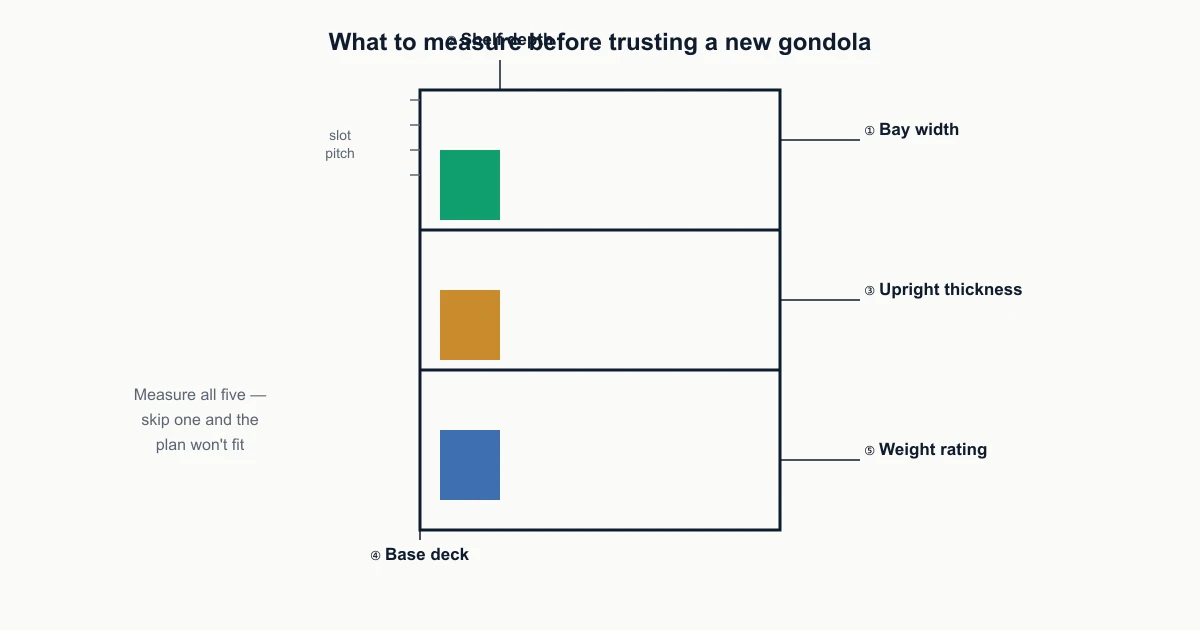
- Bay (or section): one width unit of a gondola or wall run, commonly 3 or 4 ft (about 90 or 120 cm) wide.
- Upright: the vertical post with slots that shelves hook into.
- Slot pitch (notch pitch): the distance between slots on the upright, often about 2.5 cm (1 in), which sets how finely shelf heights can be adjusted.
- Base deck: the bottom shelf, often deeper than the shelves above.
- End cap: the display at the end of an aisle. See what is an end cap.
- Peg wall / pegboard: a perforated board holding hooks for hanging products.
- Clip strip: a narrow strip hung from a shelf edge holding small impulse items.
- Label strip (shelf edge strip): the channel on the shelf front holding price labels.
The product
- SKU: stock keeping unit, one specific product variant (flavour and size).
- UPC / EAN: the barcode number identifying a product; UPC in North America, EAN in most other regions.
- Default front: the face of the pack the shopper sees; the basis for width, height and depth.
- Case pack: the number of units in a shipping case.
- Tray / shipper: packaging that holds several units on the shelf, which changes the space they take.
- Nesting: products that fit inside each other, such as stacked cups, reducing the space they need.
The numbers on a planogram
- Facing: one unit visible at the front of the shelf. "4 facings" means four units side by side.
- Units deep: how many units sit behind each facing.
- Capacity: the total units a position holds: facings × units deep × units high.
- Days of supply (DOS): capacity divided by average daily sales; how long the shelf lasts without refilling.
- Linear space: shelf length given to a product or category, in cm, inches or feet.
- Share of shelf: a brand's share of the category's linear space or facings.
- Sales per linear foot (or metre): sales divided by linear space, a common productivity measure.
- Finger space: the gap left above products so they can be lifted out, typically 1–2 cm.
The strategy
- Brand blocking: grouping one brand's products into a single block. See our brand blocking planogram guide.
- Vertical / horizontal merchandising: blocks running top to bottom vs along a shelf.
- Adjacency: which products or categories sit next to each other.
- Category flow: the order of segments along an aisle.
- Eye level (buy level): the shelf band shoppers see first, often around 120–160 cm.
- Consumer decision tree (CDT): the order in which shoppers choose: type, brand, size, price.
- Category captain: the supplier a retailer asks to advise on a category, as described in Wikipedia's category management article.
- Private label: the retailer's own brand.
The process
- POG: short for planogram.
- Schematic: another word for planogram at many retailers; sometimes a simplified line drawing.
- Modular (mod): in some US chains, the planogram for one section or the section itself.
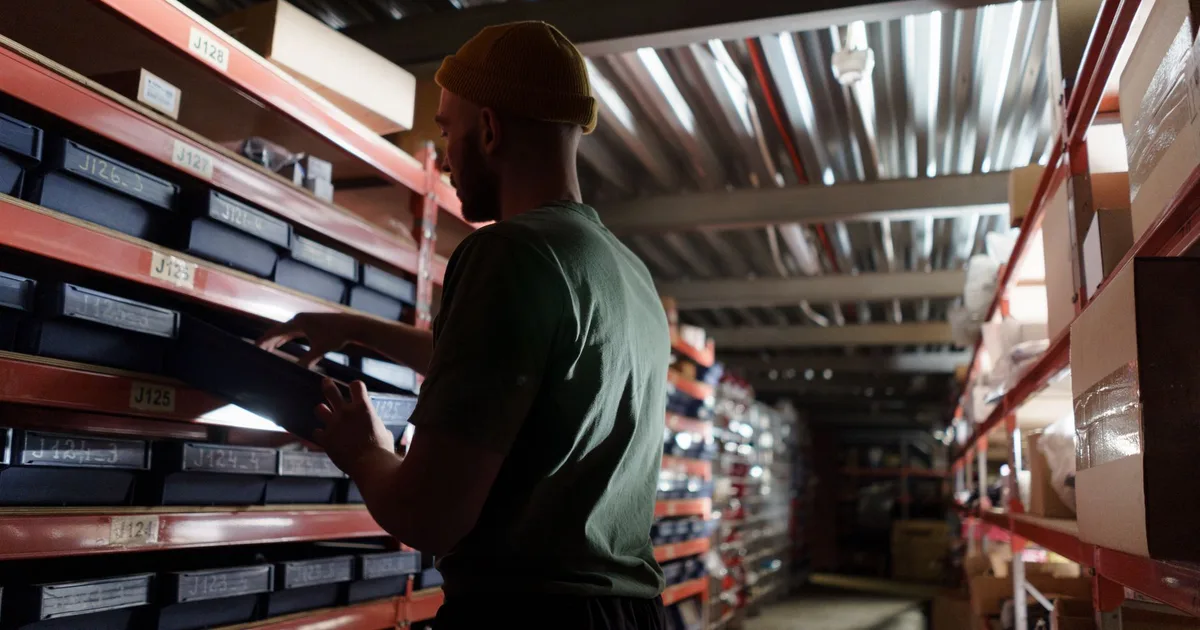
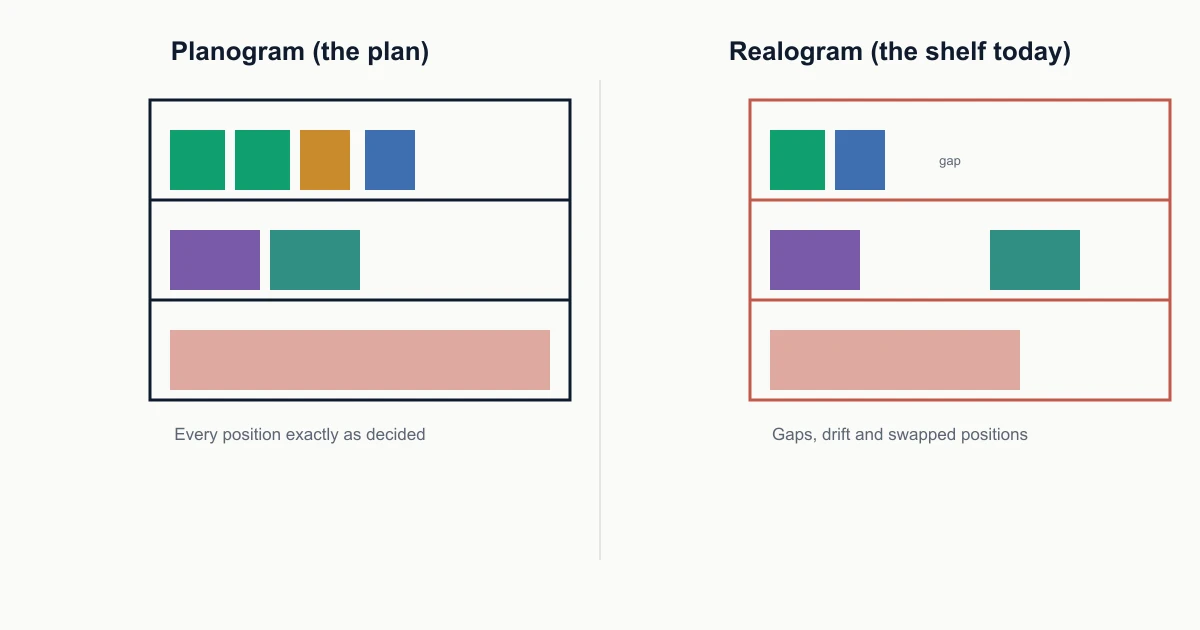
- Realogram: what the shelf actually looks like, often a photo, compared against the planogram.
- Reset: physically changing a fixture to a new planogram. See planogram reset.
- Compliance: how closely the real shelf matches the planogram.
- Cluster: a group of stores sharing the same planogram version.
- Line review: the retailer's periodic review of which products stay, go or join a category.
Share one planogram terminology glossary across the team
A team that uses one planogram terminology glossary argues less about wording and more about the shelf. Agree on the terms that vary most between companies, such as schematic, modular and section, and write your house definition next to each one.
FAQ
What does POG mean?
POG is short for planogram, the to-scale plan of where products go on a fixture.
What is a facing in retail?
One unit of a product visible at the front of the shelf. More facings mean more visibility and usually more capacity.
What is the difference between a bay and a gondola?
A gondola is the whole freestanding shelving unit; a bay is one width section of it, often 3 or 4 ft wide.
What is a realogram?
A record, usually a photo, of how the shelf actually looks. It is compared with the planogram to measure compliance.