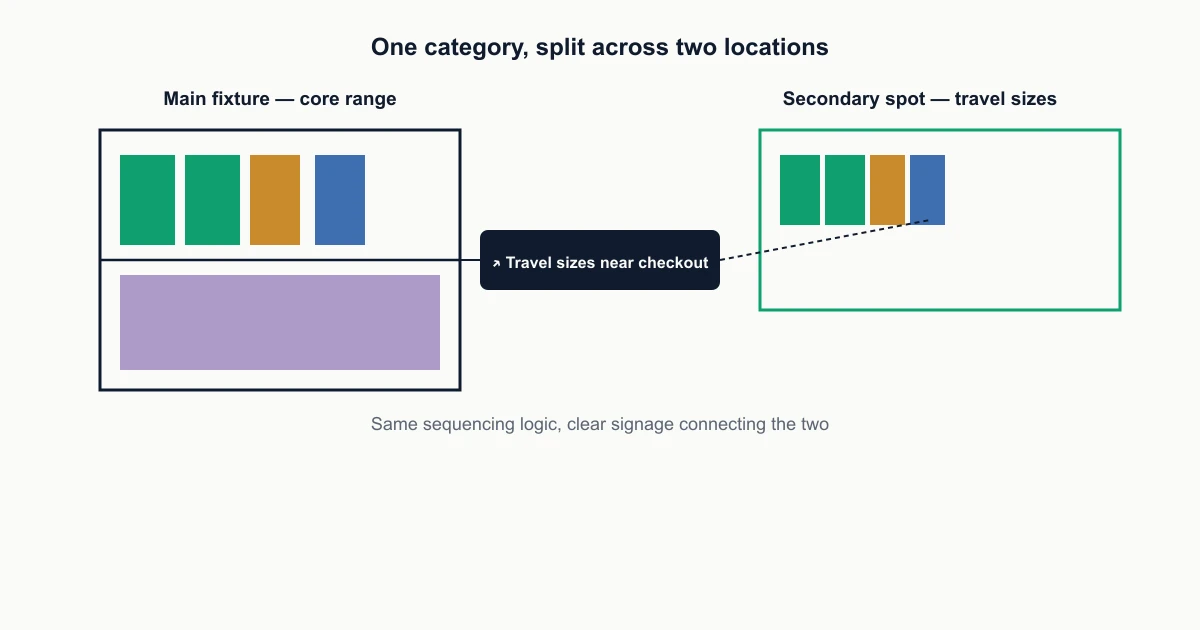
A category that's grown beyond what one fixture can hold eventually has to spill onto a second — a nearby end cap, an adjacent bay, a secondary display elsewhere in the store. Done deliberately, this can work well. Done as an afterthought extension of whatever space happened to be free, it usually confuses more shoppers than it serves.
Why a split category is riskier than it looks
A single fixture gives a shopper one place to find everything in a category, following one consistent sequence. Splitting across two locations breaks that assumption — a shopper who finds part of what they want on the main fixture has no inherent reason to expect the rest is somewhere else entirely, unless the split is designed and signposted specifically to guide them there.
What makes a split category layout work
A deliberate logic for what goes where, not just "whatever didn't fit." The most reliable approach is splitting by a meaningful distinction the shopper already understands — core, everyday items on the main fixture, and a clearly related but distinct subset (travel sizes, a seasonal variant, a specific sub-type) on the second location — rather than an arbitrary overflow split.
Clear signage connecting the two locations. If a shopper is meant to know the second location exists, something at the main fixture needs to tell them — an unsignposted second location functions, from the shopper's perspective, as a completely separate, undiscoverable mini-category.
Consistent sequencing logic across both locations. If the main fixture is sequenced by type then brand, the secondary location should follow the same internal logic, not a different one — inconsistency between the two makes the split feel disorganized rather than deliberate.
A clear rule for which location is "primary" for compliance and inventory purposes, so a stockout isn't ambiguous about which location's facings are supposed to cover it.
When splitting is worth doing versus when it's a sign of a bigger problem
A split category can genuinely work when the secondary location serves a distinct purpose — proximity to a complementary category, a natural secondary-display opportunity. It's a weaker solution when it's simply masking a category that has outgrown its allocated space and needs a real space-allocation conversation at the next category review, not a permanent workaround.
This pairs naturally with two categories sharing one fixture, which tackles a closely related piece of the same problem. This overlaps with bulk bin merchandising, which is worth checking if that's also part of your situation. A closely related question is personal care planogram, which tends to come up around the same time.
FAQ
Should a split category's secondary location always be physically close to the main fixture?
Proximity helps shoppers connect the two locations intuitively, but it's not strictly required if the secondary location has a clear, logical reason to be elsewhere (for example, near a complementary category) and is well signposted.
How do you decide which items go on the main fixture versus the secondary location?
The clearest approach uses a distinction shoppers can predict — core versus specialty, standard size versus travel size — rather than simply filling whichever fixture has space first, which tends to produce an illogical split.
Is a category split a permanent solution or a temporary fix?
It can be either, but it's worth periodically revisiting at category review time — if the split exists purely because the category outgrew its space, that's a signal to reconsider overall space allocation, not just maintain the workaround indefinitely.


