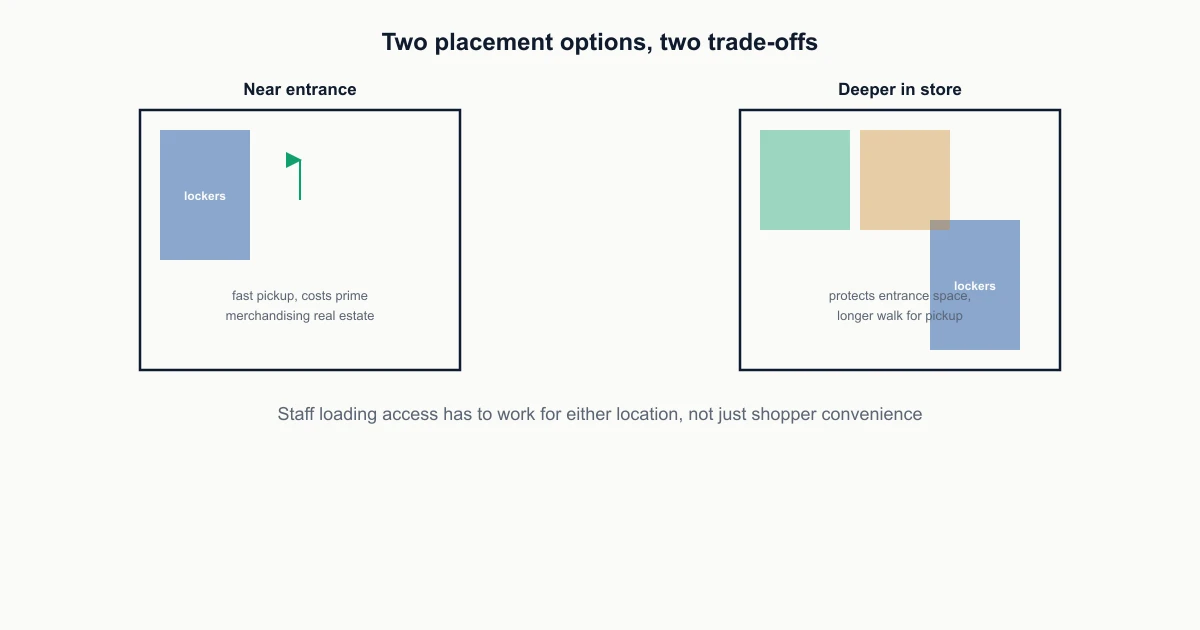
A click-and-collect pickup locker is a fixture like any other, competing for floor space and affecting the traffic patterns around it the same way a large display or an end-cap would. Click-and-collect locker placement in store is often decided primarily by operational convenience — wherever staff can easily load it — without enough weight given to how it interacts with nearby shelving, customer flow, and the space it displaces.
Weighing accessibility against shelf-adjacent disruption
A locker near the entrance is convenient for pickup customers who want a fast, low-friction visit, but entrance zones are also prime merchandising real estate, and a large locker fixture there can meaningfully cut into both selling space and the decompression zone shoppers need to orient themselves when entering. A locker placed deeper in the store protects that prime entrance space but asks pickup customers to walk further, which works against the "fast and easy" value proposition that makes click-and-collect appealing in the first place.
Staff workflow is a real constraint, not a secondary concern
Lockers need to be loaded efficiently by staff, often from a backroom or fulfillment area, and a location that's convenient for shoppers but awkward or time-consuming for staff to restock creates an ongoing operational cost that can outweigh the customer-facing benefit of an otherwise ideal location. Balancing customer accessibility against realistic staff loading routes is a genuine trade-off, not a box to check after the "ideal" customer-facing spot is already chosen.
Practical factors worth weighing in the placement decision
- Proximity to parking or a quick-exit path matters more for this fixture than for most in-store displays, since a meaningful share of pickup customers value speed and may not want to walk deep into the store at all.
- The space displaced by the locker has an opportunity cost that should be weighed against the convenience and service benefit it provides, the same as any other major non-selling fixture.
- Staff loading access needs a realistic, efficient route from wherever fulfilled orders are staged, which may rule out an otherwise ideal customer-facing location if the backend logistics don't support it well.
- Signage and wayfinding to the locker matter as much as its physical position, since even a well-placed locker underperforms if customers can't find it quickly after entering.
See aisle width and accessibility code for a related breakdown that often comes up alongside this. This pairs naturally with case pack rounding problem, which tackles a closely related piece of the same problem. This overlaps with moq vs shelf capacity, which is worth checking if that's also part of your situation.
FAQ
Should a click-and-collect locker always go near the store entrance?
It's a strong default for customer convenience, but it has to be weighed against the entrance space's merchandising value and the realistic staff loading route — in some stores, a slightly less prominent location with better staff access performs better overall.
How much floor space does a pickup locker installation typically need?
It varies by locker size and configuration, but it should be evaluated the same way any other major fixture would be — as real selling space given up in exchange for the service benefit, not as a free addition to the floor plan.
Does locker placement affect nearby shelf performance?
It can, in both directions — strong locker traffic can expose nearby shelving to more foot traffic, while a large, visually dominant locker fixture can also reduce the visibility of adjacent product if not planned carefully.


