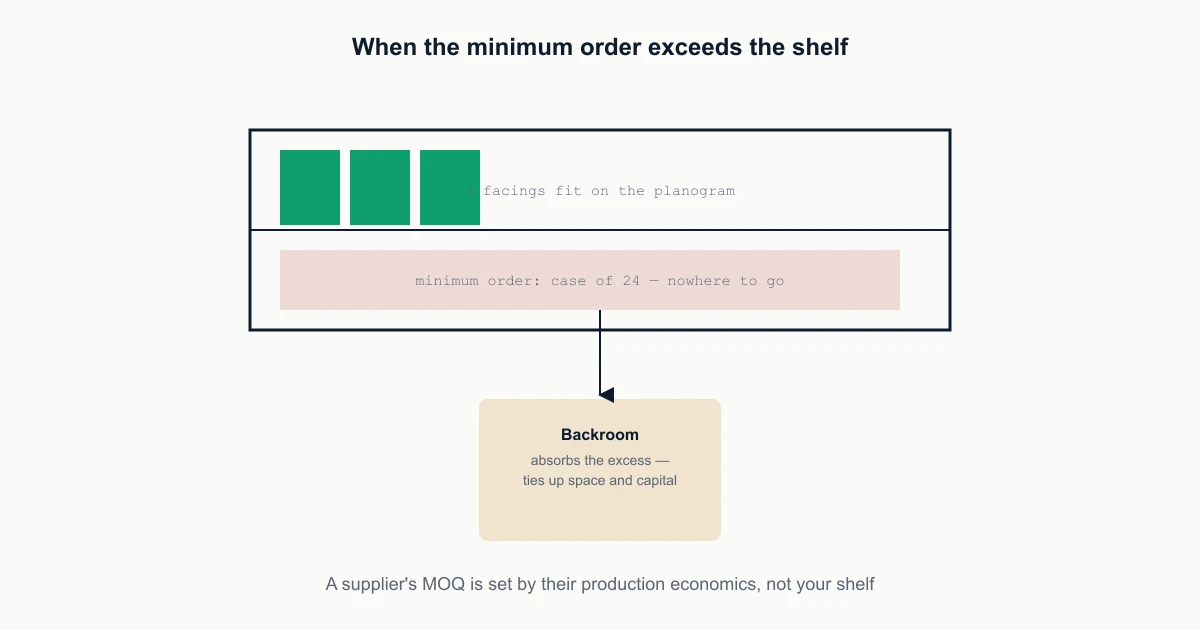
A supplier's minimum order quantity is set by their production and shipping economics, not by how much physical shelf space a retailer has available for that product. Most of the time these two numbers coexist without friction. But when MOQ vs shelf capacity actually conflicts — when the minimum order is larger than what the planogram can hold plus reasonable backroom buffer — a store ends up with inventory it's contractually or practically obligated to accept but has nowhere good to put.
Where this conflict actually shows up
It's most common with smaller or newer suppliers who haven't yet built the flexible, lower-MOQ production runs that larger established suppliers offer, and with niche or specialty products carried in limited facings specifically because they're a smaller, slower-moving part of the category. A product earning three facings on the planogram, from a supplier with a MOQ built around much larger retail partners, is a textbook case of this mismatch.
The real cost isn't just backroom clutter
Excess inventory from an oversized minimum order ties up working capital, risks obsolescence or expiry for anything with a shelf life, and creates a backroom management burden that's easy to underestimate when the conflict is evaluated purely as a one-time ordering inconvenience rather than an ongoing operational cost.
Ways to actually resolve the mismatch
- Negotiate a lower MOQ directly, especially once a product has a sales track record — suppliers are often more flexible for an established listing than they were at initial negotiation, since the retailer is now a lower-risk, proven partner for that SKU.
- Increase the planned facing count if sales data genuinely supports more space, rather than assuming the current facing count is fixed — sometimes the shelf plan is under-facing a product relative to what it could actually sell if given more room.
- Use secondary or promotional display space to absorb excess inventory temporarily, turning a minimum-order mismatch into a short-term promotional opportunity rather than pure backroom overflow.
- Consider whether the product belongs in the assortment at all if the mismatch is persistent and unresolvable — a SKU that chronically can't align supply quantity with available space may be a poor structural fit for the store's format, regardless of how well it performs per facing.
This overlaps with case pack rounding problem, which is worth checking if that's also part of your situation. A closely related question is switching distributors and case pack changes, which tends to come up around the same time. This connects to cross-elasticity between adjacent categories — the two are usually worth planning together.
FAQ
Is a MOQ vs shelf capacity conflict more common with new suppliers?
Often, yes — newer or smaller suppliers are less likely to have flexible, low-MOQ production options built around smaller retail partners, which makes this mismatch more likely early in a supplier relationship than later once trust and volume have built up.
Should a store just accept a larger facing count to absorb a high MOQ?
Only if the sales data genuinely supports it — expanding facings purely to absorb excess inventory, without underlying sales justification, usually just relocates the overstock problem from the backroom to the shelf instead of actually solving it.
Can backroom storage be a permanent solution to this mismatch?
It can work as a short-term buffer, but relying on it long-term ties up backroom space and capital indefinitely — it's better treated as a temporary accommodation while negotiating a better MOQ or facing arrangement, not a permanent fix.


