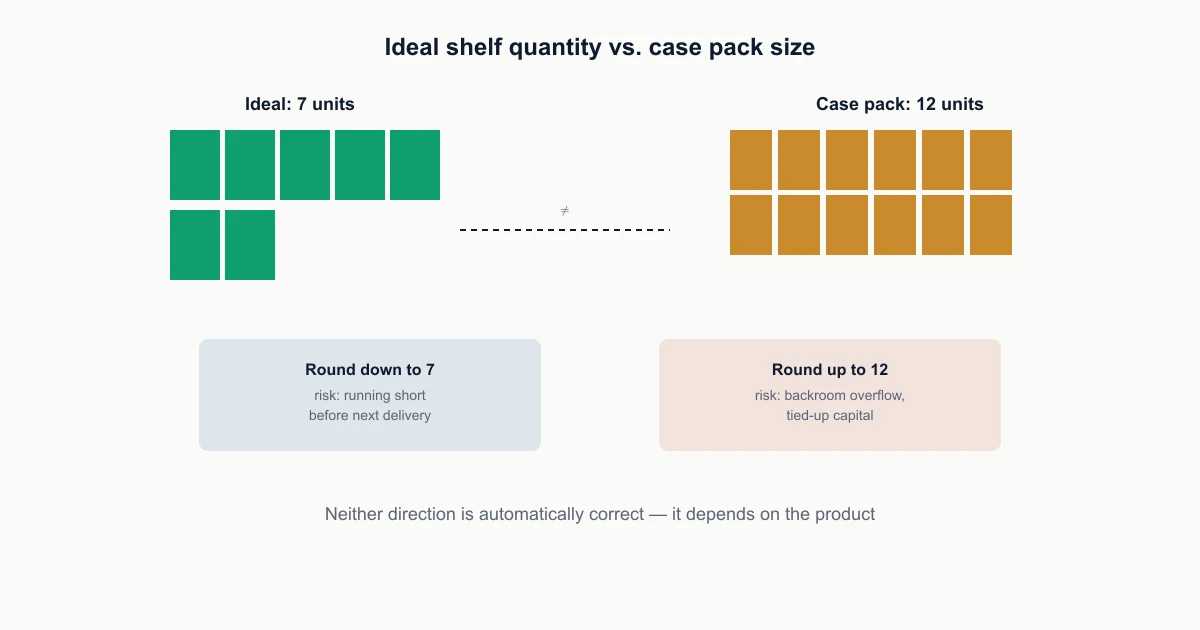
A planogram often calculates an ideal facing count based on sales velocity and available space, landing on a precise number like seven units. But the product ships in cases of twelve. That gap between the mathematically ideal facing count and the actual case pack quantity is the case pack rounding problem, and it shows up constantly in real-world shelf planning even though most facing-count formulas don't account for it at all.
Why you can't just order exactly what the shelf needs
Suppliers ship in fixed case quantities, and a store generally can't order a fraction of a case. If the ideal shelf quantity is seven units but the case holds twelve, the store either rounds down to a quantity that under-stocks relative to the calculated ideal, or rounds up and ends up with backroom overflow, excess inventory tying up capital, or a facing count beyond what the shelf space was actually planned for.
Rounding direction isn't a neutral choice
Rounding down protects against overstock and backroom clutter but risks running out before the next delivery, especially for anything with meaningful sales velocity. Rounding up avoids stockouts but ties up more capital and physical space than the calculated ideal justified. Neither direction is automatically correct — the right call depends on the product's margin, how costly a stockout is for that specific category, and how much backroom or shelf overflow space is actually available to absorb the excess.
Practical ways to reduce the friction
- Push for smaller case or inner-pack sizes on products where the mismatch is large and recurring, especially for slower-moving SKUs where a big case size creates a persistent rounding problem every single order cycle.
- Build the rounding decision into the replenishment system rather than leaving it to ad hoc judgment at the time of ordering — a documented default rule (round down for low-velocity items, round up for high-velocity items near a stockout risk threshold) keeps the decision consistent across a large SKU count.
- Reconsider the planned facing count itself when the mismatch is severe — sometimes the better fix isn't rounding the order, it's adjusting the shelf plan's ideal facing number to land closer to a clean multiple of the actual case pack.
- Track which SKUs have a chronic rounding mismatch and flag them for supplier conversations about case pack size specifically, rather than treating every instance as a one-off ordering decision.
Worth checking next: moq vs shelf capacity, which covers a closely related part of the same decision. This is closely tied to switching distributors and case pack changes, and the two often need to be solved at the same time. If this is a recurring issue in your stores, qr codes on shelf tags covers a closely related angle worth checking.
FAQ
Is the case pack rounding problem worse for slow-moving or fast-moving products?
It tends to bite hardest on slower-moving products, where even a modest case size represents many weeks of supply relative to actual sales — a fast-moving product usually sells through a rounded-up order quickly enough that the mismatch barely registers.
Can inner packs solve this problem?
Often, yes — a case built from several smaller inner packs gives more granular ordering flexibility than a single large case, which is part of why inner pack size is worth negotiating directly with suppliers for problem SKUs.
Should the planogram's facing count be adjusted to match case pack size instead of the other way around?
For some SKUs, yes — treating the case pack as a constraint and setting the facing count to a clean multiple of it can be more practical than repeatedly fighting a mismatch every single order cycle.


