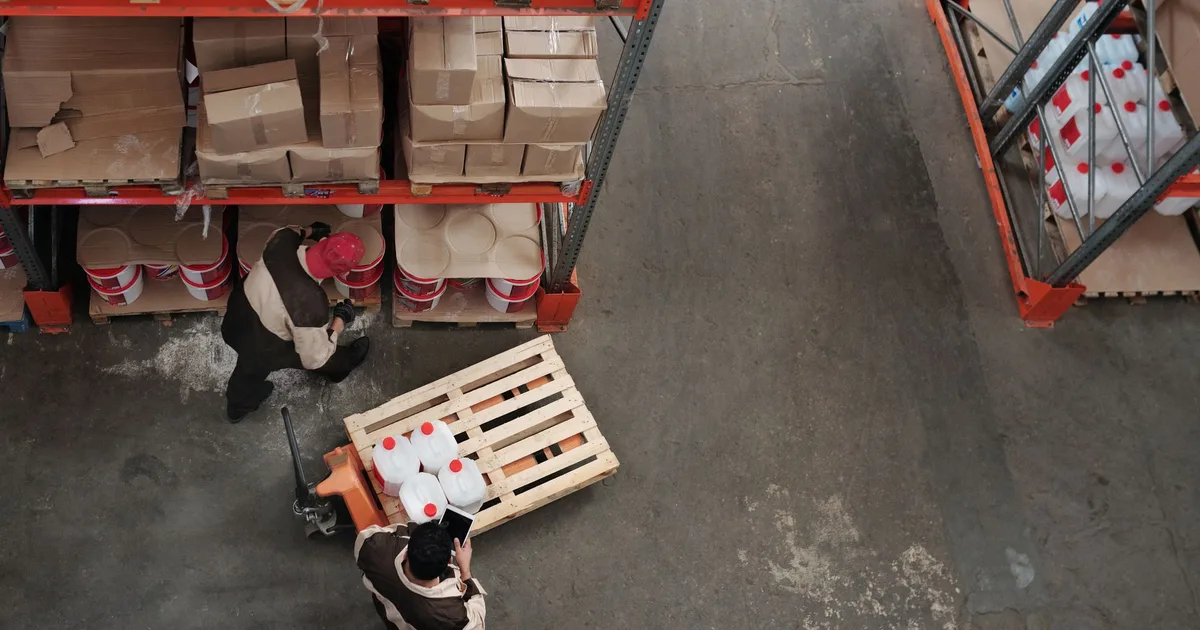
Club store planograms are built around a different planning unit entirely than traditional grocery or big-box layouts. Instead of shelf facings — units wide, units deep, on a fixed shelf — the core unit is the pallet: a stacked, floor-staged footprint that functions as its own display.
Why pallets, not shelves
Club stores operate on a deliberately limited assortment, with real estate allocated in large, efficient blocks rather than narrow shelf runs. A pallet display suits this model because it lets a single, large unit of product occupy and sell down from one footprint, restocked as a whole pallet rather than facing by facing — far more labor-efficient at the volumes club retail depends on.
What changes when the planning unit is a pallet
The relevant dimensions are footprint and height, not facing width and shelf depth. A club planogram has to account for how a pallet's base footprint fits the floor plan and how tall the stack can go before it becomes a safety or stability concern, rather than calculating facings across a shelf run.
Packaging has to work as its own billboard. Without individual shelf facings framing the product, the outer case or pallet wrap itself becomes the primary visual communication — readable from a distance, since that's how shoppers encounter it from across a wide aisle.
Restocking logic is simpler but less granular. A pallet gets replaced as a whole unit once it sells down, rather than topped up facing by facing — this reduces labor per restock event but means the display's visual fullness (and therefore its draw) degrades more noticeably as the pallet sells through.
Space allocation is unusually strict. Club retailers are known for tightly controlling how much floor space any given pallet position gets, since floor space is the limiting resource in a way shelf space is in traditional grocery.
What this means for a supplier planning for club retail
- Design packaging to communicate at pallet scale, not shelf-facing scale — what reads clearly on a single unit on a shelf may not read at all from across a wide club aisle.
- Plan pallet dimensions to fit standard club footprints and height limits, confirmed with the specific retailer rather than assumed from general club conventions.
- Expect restocking cadence to follow pallet sell-through, not a shelf-facing replenishment schedule.
- Treat club space requests as a pallet-position negotiation, distinct from the shelf-facing space conversations that apply in traditional grocery formats.
If this is a recurring issue in your stores, converting a shelf planogram to a pallet layout covers a closely related angle worth checking. See decompression zone for a related breakdown that often comes up alongside this. This pairs naturally with pop-up store merchandising, which tackles a closely related piece of the same problem.
FAQ
Do all club retailers use identical pallet specifications?
No — specific dimensions, weight limits, and display conventions vary between club retailers, so confirming the exact specification with each retailer is necessary rather than assuming one standard applies across all of them.
Can a product designed for shelf facings be adapted for club pallet display without a packaging redesign?
Sometimes, but packaging originally designed to be read at shelf-facing distance often doesn't communicate as effectively at pallet scale — a dedicated club packaging format is common for exactly this reason.
Is club store space allocation reviewed as frequently as traditional grocery category reviews?
This varies by retailer, but club retailers' well-known strictness about space allocation generally means pallet position decisions get scrutinized closely, even if the review cadence itself differs from a traditional grocery category review cycle.


