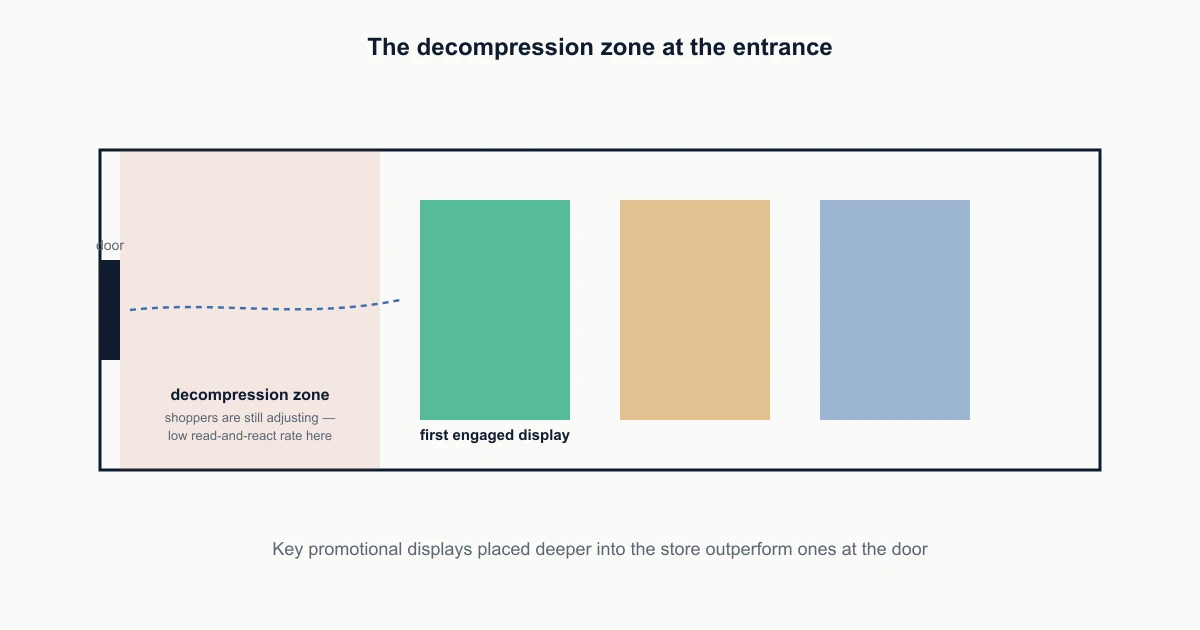
The decompression zone — the first several feet of floor space just inside a store's entrance — is a well-documented soft spot in retail performance, and it's not because retailers merchandise it badly. It's because shoppers are structurally not ready to engage with product the moment they walk in, regardless of what's displayed there.
Why this zone underperforms predictably
Shoppers need a moment to transition from outside to inside. Entering a store involves an adjustment — different lighting, different pace, often a different physical environment (leaving a parking lot or street for an indoor space) — and shoppers need a brief period to adjust before they're mentally ready to actually process and evaluate what's around them.
Attention is oriented toward getting bearings, not toward product. In the first few steps inside a store, most shoppers are subconsciously orienting themselves — where are the carts, which direction is the rest of the store, where am I actually going — rather than evaluating whatever product happens to be immediately in their path.
This pattern holds regardless of what's merchandised there. Because the underperformance is driven by shopper psychology and transition behavior rather than the specific product or display quality, even a well-designed, well-stocked display in this exact zone tends to underperform an equally good display positioned a short distance further in.
What this means for how the zone should be used
Avoid placing your highest-stakes, highest-margin merchandising bets in the first few feet. A premium or high-priority display deserves a position where shoppers have already transitioned into an attentive, evaluative mindset, not the zone where they're still orienting themselves.
Use the space for lower-stakes, high-visibility purposes instead. Seasonal signage, general store navigation cues, or broad brand messaging that doesn't require a considered purchase decision can work reasonably well here, since they don't depend on the deep engagement this zone structurally struggles to produce.
Don't interpret weak performance in this zone as evidence a specific display failed. Comparing a decompression-zone display's performance against a display elsewhere in the store without accounting for this zone's known underperformance can lead to the wrong conclusion about what actually worked.
Practical guidance
- Reserve the first several feet for orientation, wayfinding, or low-stakes messaging, not your most important merchandising decisions.
- Move high-priority seasonal or promotional displays further into the store, past the point where shoppers have naturally transitioned into a more attentive mindset.
- Benchmark this zone's performance against itself over time, not against deeper in-store positions, to get a fair read on whether something there is actually working.
This pairs naturally with club store planograms, which tackles a closely related piece of the same problem. This overlaps with pop-up store merchandising, which is worth checking if that's also part of your situation. A closely related question is convenience store vs supermarket planogram, which tends to come up around the same time.
FAQ
How far into a store does the decompression zone typically extend?
This varies by store size and entrance design, but it's generally described as the first several feet — roughly the space a shopper crosses before they've had a moment to adjust and start actively orienting toward the store layout.
Can anything be done to shorten the decompression effect?
Store design choices — lighting transition, clear immediate sightlines to orientation cues like carts or directory signage — can help shoppers transition faster, but the effect itself is a fairly consistent feature of how people enter unfamiliar or semi-familiar spaces.
Does the decompression zone concept apply to every store format?
The underlying psychological transition effect is broadly consistent, though its practical impact can vary by format — a small, fast-transaction convenience store format experiences it differently than a large-format store with a longer walk from entrance to the main shopping area.


