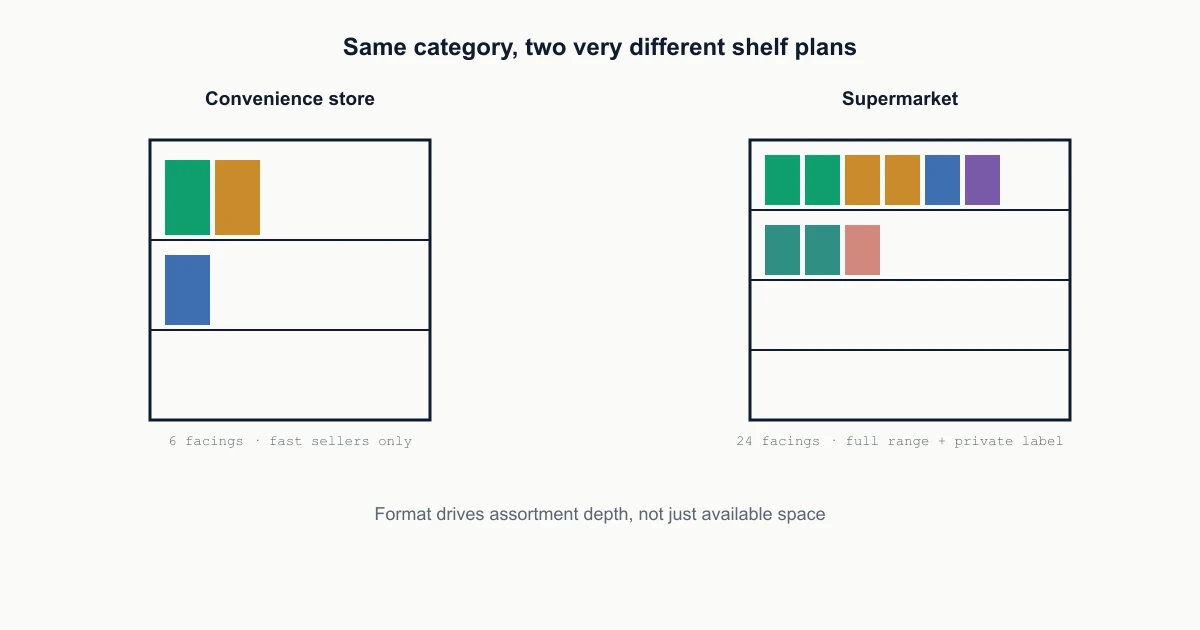
A convenience store vs supermarket planogram comparison isn't really about scale alone — a c-store planogram isn't just a supermarket layout compressed into less space. The two formats serve different shopping missions, and the planning logic needs to reflect that, not just shrink the same assortment to fit a smaller footprint.
What actually differs beyond size
The shopping mission is fundamentally different. A supermarket trip is often planned, multi-item, and comparison-driven. A convenience store trip is typically fast, single-purpose, and time-sensitive — a shopper usually knows exactly what they came for and wants to find it with minimal navigation.
Assortment depth gives way to assortment focus. Where a supermarket planogram can afford to offer many options per category to serve different preferences, a c-store planogram has to be more selective, stocking the items most likely to satisfy the fast, specific missions its shoppers actually come in for — fewer choices, chosen more deliberately.
Checkout and impulse zones carry disproportionate weight. With less space overall, the checkout and near-checkout area represents a larger share of total store space and sales opportunity in a c-store than in a supermarket, making impulse merchandising decisions here especially consequential.
Fresh and food-to-go categories play a different role. Many convenience formats lean more heavily on prepared food, coffee, and grab-and-go items relative to their overall footprint than a typical supermarket does, reflecting the quick, often meal-replacement nature of many c-store visits.
Restocking cadence and labor model differ. Smaller staff counts and more frequent, smaller deliveries are common in convenience formats, which affects how facings and days-of-supply calculations should be approached compared to a larger-format store's delivery cycle.
Why simply shrinking a supermarket plan doesn't work
Applying a proportional reduction to a full supermarket planogram — the same approach that fails when a single store's footprint shrinks — fails even more clearly moving between formats entirely, because the shopper mission itself has changed, not just the available space. A convenience store needs a plan built from its own shopper logic, not a compressed version of a different format's logic.
Building a convenience-specific plan
- Start from the convenience shopper's actual missions (quick snack, fuel-and-go, forgotten grocery item) rather than a scaled-down supermarket category list.
- Prioritize the checkout and near-checkout zone deliberately, given its outsized share of total store impact in this format.
- Keep assortment focused on proven, high-confidence choices per category, rather than trying to offer supermarket-level variety in a fraction of the space.
- Build facings around the format's actual delivery cadence, which often differs meaningfully from a supermarket's.
A closely related question is airport and travel retail merchandising, which tends to come up around the same time. This connects to converting a shelf planogram to a pallet layout — the two are usually worth planning together. Worth checking next: club store planograms, which covers a closely related part of the same decision.
FAQ
Should a chain operating both formats use the same brand logic across both?
Core brand and category logic can stay consistent, but facings, assortment depth, and sequencing generally need format-specific treatment rather than a single shared planogram scaled between formats.
Is impulse merchandising more important in convenience stores than supermarkets?
Proportionally, yes — the checkout and near-checkout zone represents a larger share of total store space and shopper attention in a convenience format, making impulse merchandising decisions there especially high-leverage.
Do convenience stores need the same category review cadence as supermarkets?
The underlying need for periodic review is similar, but convenience formats may benefit from more frequent review given how concentrated and mission-specific their assortment needs to stay relevant.


