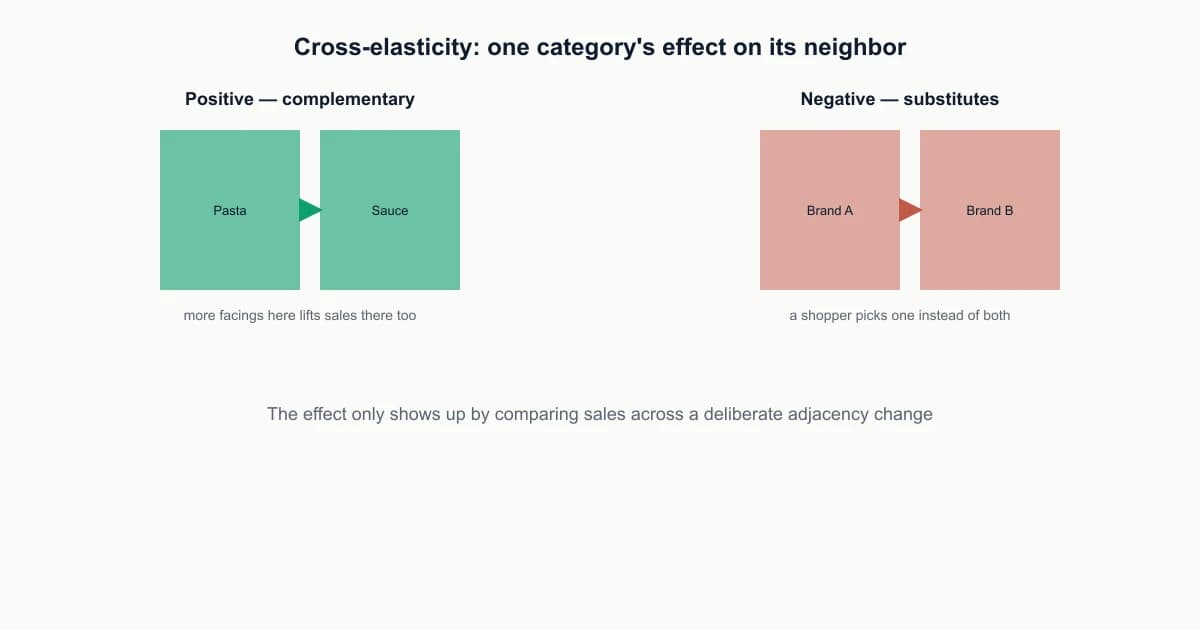
Space elasticity measures how a single category's own sales respond to changes in its own facing count — more facings, more sales, up to a point of diminishing return. Cross-elasticity between adjacent categories asks a different question: how does changing one category's facing count or presence affect sales in a neighboring category it sits next to, independent of anything that category's own facings did.
Why adjacency effects are easy to miss in standard space analysis
A space elasticity study run on one category in isolation can show that category's own facings are performing exactly as expected, while missing that a planogram change to the adjacent category actually shifted its sales. Complementary categories — like pasta and sauce, or chips and dip — can lift each other's sales through proximity alone, and competing or substitute categories can suppress each other's sales if positioned too closely together. Neither effect shows up in a category's own standalone sales data; it only becomes visible when you deliberately compare performance across a planogram change that affected the neighbor.
Positive versus negative cross-elasticity
Positive cross-elasticity happens between genuinely complementary categories, where proximity helps both — this is the formal version of the intuition behind intentional cross-merchandising. Negative cross-elasticity happens between substitute or competing categories, where shoppers choosing one option at the shelf reduces the likelihood they also buy a close alternative positioned right next to it — in these cases, tight adjacency isn't necessarily a merchandising win, even though it feels intuitive to group "similar" things together.
Using this concept in practical planogram decisions
- Test adjacency changes deliberately where possible, tracking both categories' sales before and after, rather than assuming a logical-sounding pairing will automatically produce a positive effect without verification.
- Distinguish between categories that are genuinely complementary and categories that merely feel related, since two categories can seem logically connected without shoppers actually treating them as a joint purchase decision.
- Watch for negative cross-elasticity in categories with substitute products, where closely comparing two similar options at the shelf might reduce total category spend rather than increase it, depending on how shoppers actually behave.
- Use findings to inform broader adjacency strategy across the store, not just the specific pair tested — a confirmed strong complementary relationship in one part of the store may suggest similar pairings are worth testing elsewhere.
This is closely tied to shelf space allocation methods, and the two often need to be solved at the same time. If this is a recurring issue in your stores, moq vs shelf capacity covers a closely related angle worth checking. See switching distributors and case pack changes for a related breakdown that often comes up alongside this.
FAQ
How is cross-elasticity different from a standard adjacency rule?
An adjacency rule is often based on intuition or category logic (pasta belongs near sauce). Cross-elasticity is the measured sales effect of that adjacency — confirming, with actual data, whether the intuitive pairing produces a real, quantifiable sales impact.
Can two categories have negative cross-elasticity even if they seem related?
Yes — categories that serve as substitutes for each other, where a shopper chooses one over the other rather than buying both, can show negative cross-elasticity even though they're conceptually similar and intuitively might seem like a natural pairing.
Is cross-elasticity testing practical for a smaller retailer without a dedicated analytics team?
A simplified version — comparing combined sales for two adjacent categories before and after a deliberate adjacency change — is achievable without sophisticated analytics, even if it's less statistically rigorous than a full formal study.


