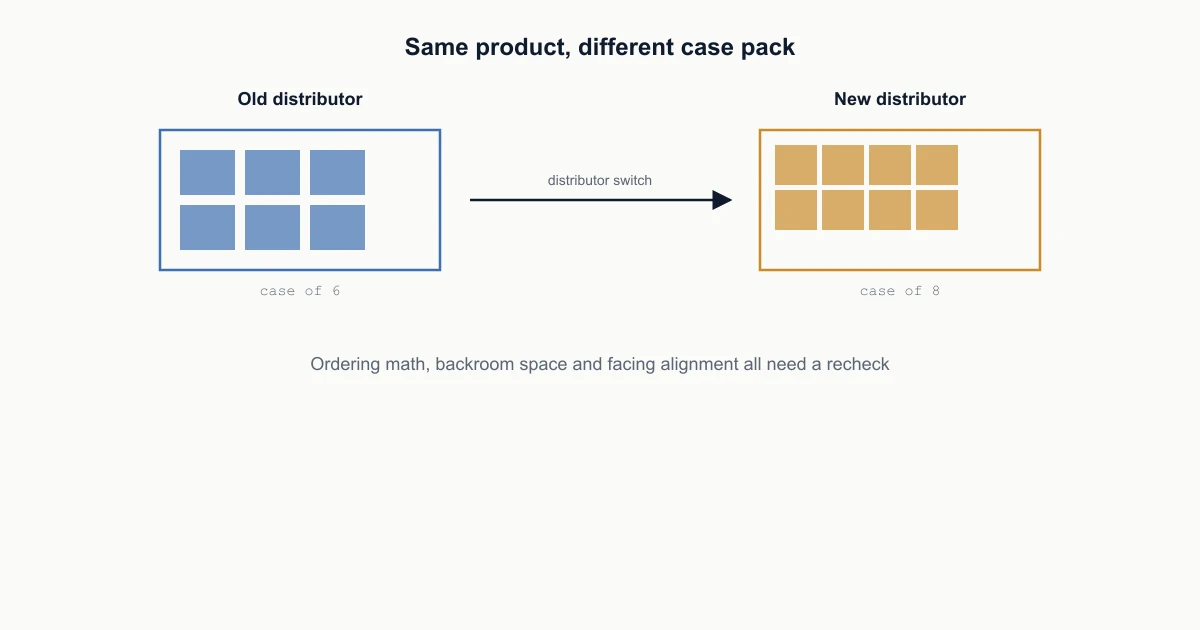
Switching distributors for an existing product can look like a purely back-office decision — same product, different logistics partner — but switching distributors and case pack changes often go hand in hand, because different distributors frequently ship the identical product in different case configurations. A planogram built around the old case size can run into ordering, backroom and shelf-fit friction the moment the new distributor's case pack arrives, even though nothing about the product on the shelf has actually changed.
Why case pack size isn't always consistent across distributors
A manufacturer may offer the same product to different distributors in different case quantities depending on regional logistics norms, the distributor's own standard ordering units, or historical arrangements specific to that distribution relationship. A retailer switching from one distributor to another for cost, service or availability reasons can discover the new case pack doesn't match the old one, which then collides with the case pack rounding and MOQ planning that was built around the previous configuration.
What actually breaks when this gets missed
Order quantities calculated against the old case size produce the wrong total units once the new case size applies. Backroom storage planned around the old case dimensions may not accommodate the new one efficiently. And if the shelf facing count was ever set to align cleanly with the old case pack specifically, that clean alignment can disappear with the new distributor's different configuration, reintroducing a rounding mismatch that didn't exist before.
What to check before (and right after) a distributor switch
- Confirm the new distributor's case pack size for every affected SKU explicitly, rather than assuming it matches the previous distributor — this is easy to overlook when the switch is being evaluated mainly on price and service terms.
- Re-run the ordering math for affected products against the new case size, checking specifically for products where the facing count was tuned to the old case pack's clean multiples.
- Flag any backroom storage adjustments needed if the new case dimensions differ meaningfully from the old ones, since this is often missed until the first delivery under the new arrangement actually arrives.
- Communicate the change to whoever manages ordering and replenishment before the switch takes effect, not after the first confusing order comes in under the new configuration.
This pairs naturally with case pack rounding problem, which tackles a closely related piece of the same problem. This overlaps with moq vs shelf capacity, which is worth checking if that's also part of your situation. A closely related question is shelf signage hierarchy, which tends to come up around the same time.
FAQ
Does every distributor switch involve a case pack change?
No — many switches involve identical case configurations, especially when the underlying manufacturer's shipping standards don't vary. But it's worth confirming explicitly rather than assuming, since the ones that do change are often missed until they cause a visible problem.
Who's responsible for catching a case pack change during a distributor switch?
Ideally whoever's negotiating the distributor change should confirm case pack details as part of the switch evaluation, with that information passed clearly to ordering and shelf-planning teams before the change takes effect.
Should the planogram's facing count change if the new case pack size changes?
It's worth reviewing, particularly for SKUs where the previous facing count was deliberately aligned to the old case pack's clean multiples — a mismatch here reintroduces the same rounding friction that a well-aligned facing count was originally designed to avoid.


