Gondola shelving is the freestanding, usually double-sided shelving unit that forms most supermarket and convenience-store aisles. It is built from bays (common widths are about 3 or 4 ft, roughly 90 or 120 cm), each with uprights, a base deck and adjustable shelves that hook into slots. Its dimensions set the limits of every shelf planogram built on it.
The word comes from the shape: a long, narrow unit standing in the middle of the floor, as described in Wikipedia's gondola entry. Wall shelving uses similar parts but has only one side.
The seven parts of a gondola
- Base: the feet and base frame resting on the floor, often with levelling feet.
- Uprights: vertical posts with a column of slots. Shelves hook into them.
- Back panels: solid, pegboard or slotted panels between uprights. Pegboard backs let you mix hooks and shelves.
- Base deck: the bottom shelf, usually deeper than the rest and close to the floor.
- Shelves: adjustable, typically in several depths.
- Kick plate: the front panel along the bottom that hides the base.
- Accessories: label strips, dividers, pushers, fences, hooks and end panels.
Two gondola runs end at the end cap, a short unit across the end of the aisle used for promotions; see what is an end cap in retail.
Sizes that matter for planograms
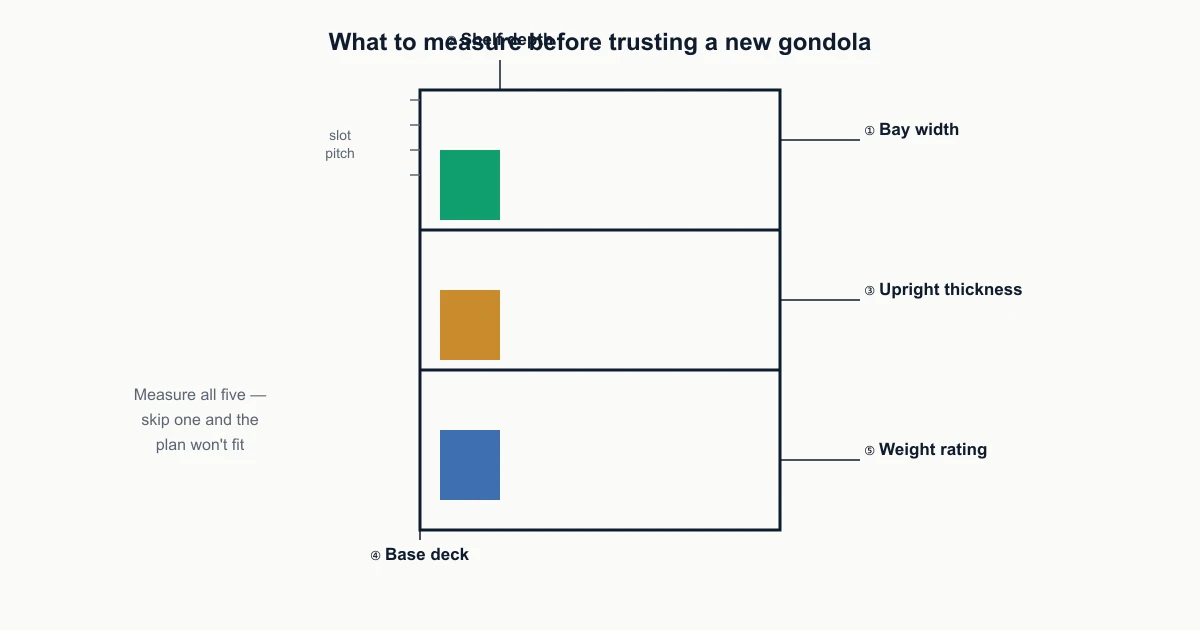
Gondola sizes vary by manufacturer and country, so always measure, but these are the dimensions that drive planograms:
| Dimension | Why it matters |
|---|---|
| Bay width | Sets how many facings fit across; 90 cm and 120 cm (3 ft and 4 ft) are common |
| Shelf depth | Sets units deep; shallow shelves for small packs, deeper ones for bulky items |
| Base deck depth | Usually deeper, suits heavy and bulky products |
| Overall height | Limits the number of shelves and the highest usable shelf |
| Slot pitch | How finely shelf heights can be adjusted, often about 2.5 cm (1 in) |
If the term is new, see what is a bay in retail shelving. A planogram built for 120 cm bays will not fit a store with 100 cm bays, which is why chains keep fixture data for every store.
How gondola shelving shapes the layout
- Eye level is fixed by the body, not the gondola. The band around 120–160 cm (47–63 in) gets the best sellers regardless of unit height.
- Shelf count is a trade-off. More shelves give more facings but less clearance; tall products need gaps. Check clearance per shelf.
- Heavy items go on the base deck, both for safety and because the base is usually the strongest and deepest.
- Double-sided runs share a spine. Products on one side should not need more depth than half the unit allows.
Weight matters too. Shelves have load ratings; heavy categories such as drinks and detergents should stay within them. OSHA's general rule on material storage reminds operators that stacked goods must stay stable.
Planning products on a gondola
- Record bay width, shelf depths and current shelf heights for each store or cluster.
- Set shelf heights from the products, tallest at the bottom, leaving 1–2 cm of finger space.
- Fill the eye-level band with best sellers, the base deck with heavy and large packs.
- Check facings fit each shelf's width, and units deep fit its depth. The shelf capacity calculator handles this quickly.
Measure the gondola before you plan it
Gondola shelving looks standard, but bay width, shelf depth and slot pitch differ between stores and suppliers. Measure them, store the numbers with each planogram, and every plan you send will fit the shelf it is meant for.
FAQ
What is gondola shelving used for?
Displaying products in the middle aisles of supermarkets, convenience stores and pharmacies. Most are double-sided and freestanding.
What is the standard size of a gondola shelf?
There is no single standard. Bay widths of about 3 ft and 4 ft (90 and 120 cm) are common, with shelf depths from shallow to deep depending on the category.
What is the difference between a gondola and wall shelving?
A gondola is freestanding and usually double-sided. Wall shelving is fixed against a wall and has products on one side only.
Can you hang products on a gondola?
Yes, if it has pegboard or slotted back panels. Hooks and shelves can then be mixed on the same bay.