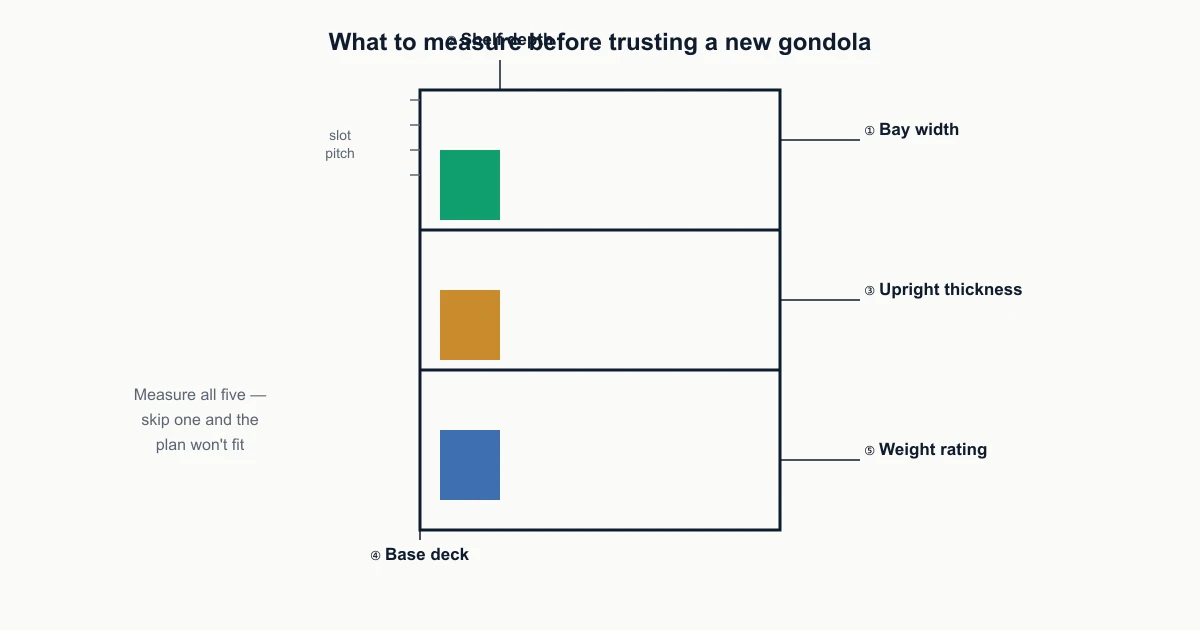
What is a bay in retail shelving? A bay is one width section of a shelving run, measured from one upright to the next. Common bay widths are about 3 ft and 4 ft (roughly 90 cm and 120 cm), and a category's space is often described in bays, for example "soft drinks has six bays" or "coffee is 4 feet". On a planogram, each bay is drawn as one section with its own shelves.
Some retailers call it a section or module; the meaning is the same.
How bays fit into a shelving run
- Upright: the vertical post with slots that shelves hook into.
- Bay: the space between two uprights, with its own set of shelves.
- Run: several bays joined in a line, forming one side of an aisle.
- Gondola: usually two runs back to back, freestanding in the aisle, one of several retail fixture types.
Because neighbouring bays share uprights, shelves in adjacent bays can be set at different heights, which lets one category use tall shelves next to another using short ones.
What is a bay in retail shelving, in centimetres?
| Bay width | Approx. metric | Where it is common |
|---|---|---|
| 3 ft | about 90 cm | Smaller stores, narrow categories |
| 4 ft | about 120 cm | Supermarket aisles |
| Metric standards | 100 cm, 125 cm, 133 cm and others | Many markets outside North America |
Always measure. "4 ft" bays from different manufacturers can differ by a few centimetres inside the uprights, enough to lose a facing.
Why bays matter in planograms
- Space is allocated in bays. Category managers and space planners talk in bays or linear feet when dividing an aisle.
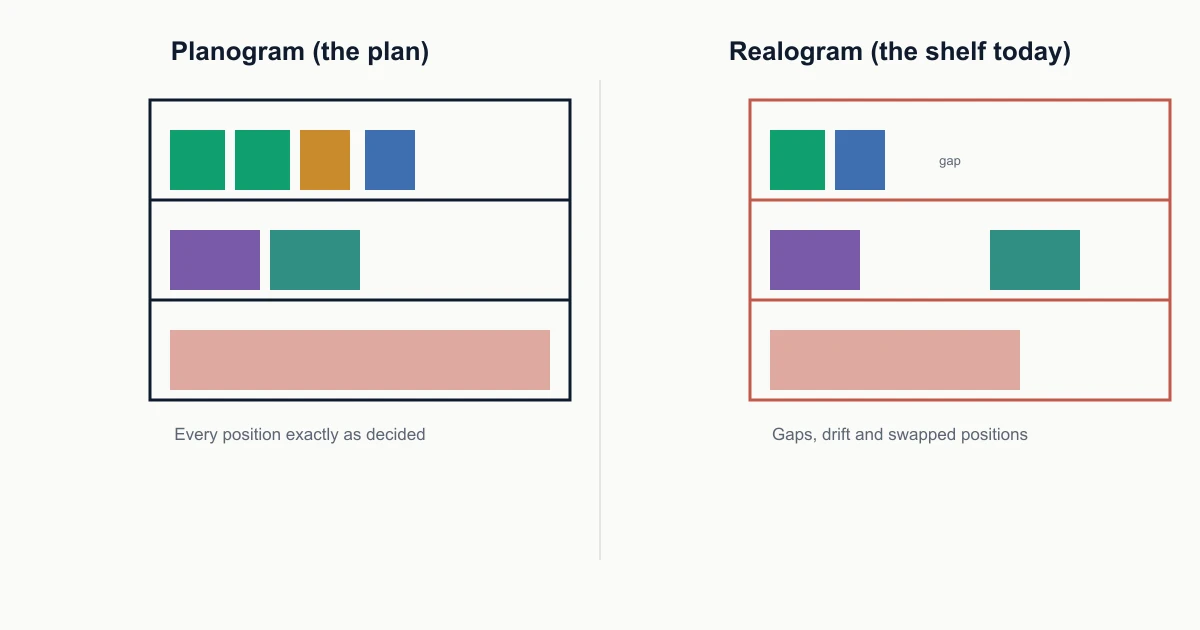
- Plans are drawn per bay. A six-bay planogram is six sections side by side.
- Store versions follow bay counts. A store with four bays of a category needs a different plan from one with six; see how to cluster stores for planograms.
- Blocks cross bays carefully. A brand block that splits across an upright looks broken; good plans keep blocks within bays or align them deliberately.
Counting linear space from bays
Linear space = number of bays × bay width × number of shelves.
Six 120 cm bays with five shelves give 6 × 120 × 5 = 3,600 cm, or 36 m of shelf. This figure feeds metrics such as sales per linear metre and share of shelf. For capacity at product level, see how to calculate shelf capacity.
Bays are the unit of shelf space
So, what is a bay in retail shelving? It is the building block of every aisle and the unit in which shelf space is bought, allocated and planned. Know your bay widths per store and every planogram becomes easier to fit. Wikipedia's gondola entry and its planogram entry offer further background.
FAQ
How wide is a shelving bay?
Commonly about 3 ft or 4 ft (90 or 120 cm), though metric widths such as 100 cm or 125 cm are also widespread. Measure inside the uprights.
What is the difference between a bay and a section?
Usually none; many retailers use the words interchangeably for one width unit of shelving.
How many shelves does a bay have?
It varies by category and height, often four to seven shelves including the base deck.
What does "4 feet of space" mean in retail?
The category or brand gets shelving 4 ft wide, typically one 4 ft bay from top to bottom.