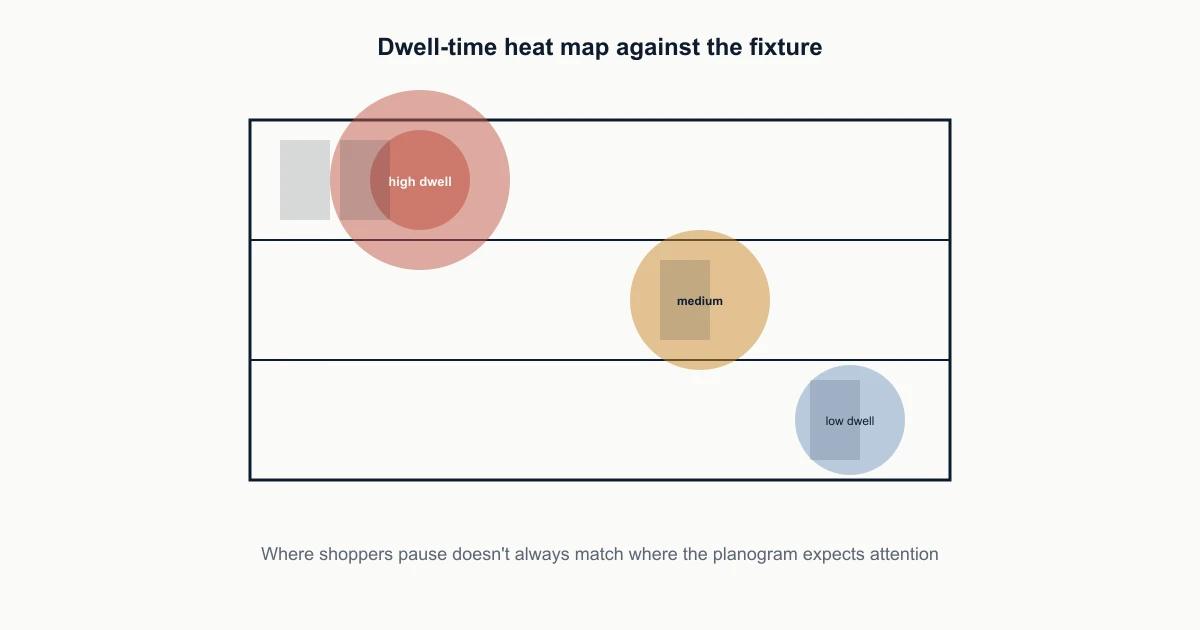
Heat-mapping shopper dwell time captures where shoppers actually pause, slow down, or spend time looking, using in-store sensors or camera-based tracking — giving a direct view of attention that sales data alone can't provide. Sales tell you what was bought; dwell-time heat mapping can tell you what was actually looked at, including products that got attention but didn't convert.
What dwell-time data reveals that sales data can't
Attention that doesn't convert to a sale. A product or display getting meaningful dwell time but weak sales points to a different kind of problem than low attention altogether — the issue may be price, packaging, or a decision barrier at the point of consideration, not a visibility problem the planogram itself could fix.
Whether assumed high-traffic zones actually get the attention they're assumed to. Positions commonly treated as premium — eye level, end caps, checkout proximity — can be validated or challenged with actual dwell-time evidence specific to a store, rather than relying purely on general merchandising convention.
How shoppers actually move through and pause within a category, which can reveal whether a planned sequencing logic matches real navigation behavior or whether shoppers are moving through the category differently than the layout assumed.
The relative attention-grabbing power of different signage or display treatments, by comparing dwell time around various merchandising approaches directly rather than inferring effectiveness from sales alone.
Using this data to inform planogram decisions
Compare dwell time against sales conversion for the same positions, distinguishing an attention problem (low dwell time) from a conversion problem (attention without resulting sales) — these call for different fixes.
Validate assumed premium positions with actual local data, since dwell-time patterns can vary by store layout and shopper base in ways a general merchandising rule of thumb doesn't capture.
Use dwell-time evidence to test sequencing or signage changes, similar in spirit to A/B testing planogram variants, but focused specifically on the attention layer rather than final sales outcomes alone.
Treat this as a complement to sales and compliance data, not a replacement, since dwell time measures attention, not purchase intent or actual transaction outcomes.
Limitations worth keeping in mind
Dwell-time tracking technology and deployment cost varies, and not every store or category will have access to this kind of data. Privacy considerations around in-store tracking also vary by jurisdiction and need to be handled appropriately, similar to other customer data collection methods.
This is closely tied to loyalty card data for shelf placement, and the two often need to be solved at the same time. If this is a recurring issue in your stores, airport and travel retail merchandising covers a closely related angle worth checking. See eye level is buy level for a related breakdown that often comes up alongside this.
FAQ
How is shopper dwell time typically measured in-store?
Methods vary and include camera-based computer vision analysis, Wi-Fi or Bluetooth signal tracking of mobile devices, and dedicated in-store sensors — the specific technology affects both accuracy and privacy considerations.
Does high dwell time always mean a position is working well?
Not necessarily — high dwell time without corresponding sales conversion can actually indicate a problem (confusion, a pricing or value concern) rather than success, which is why dwell time should be read alongside conversion data, not alone.
Are there privacy considerations specific to dwell-time tracking?
Yes — depending on the technology and jurisdiction, in-store shopper tracking can carry real privacy and consent obligations, making it important to confirm compliance with applicable regulation before deploying this kind of system.


