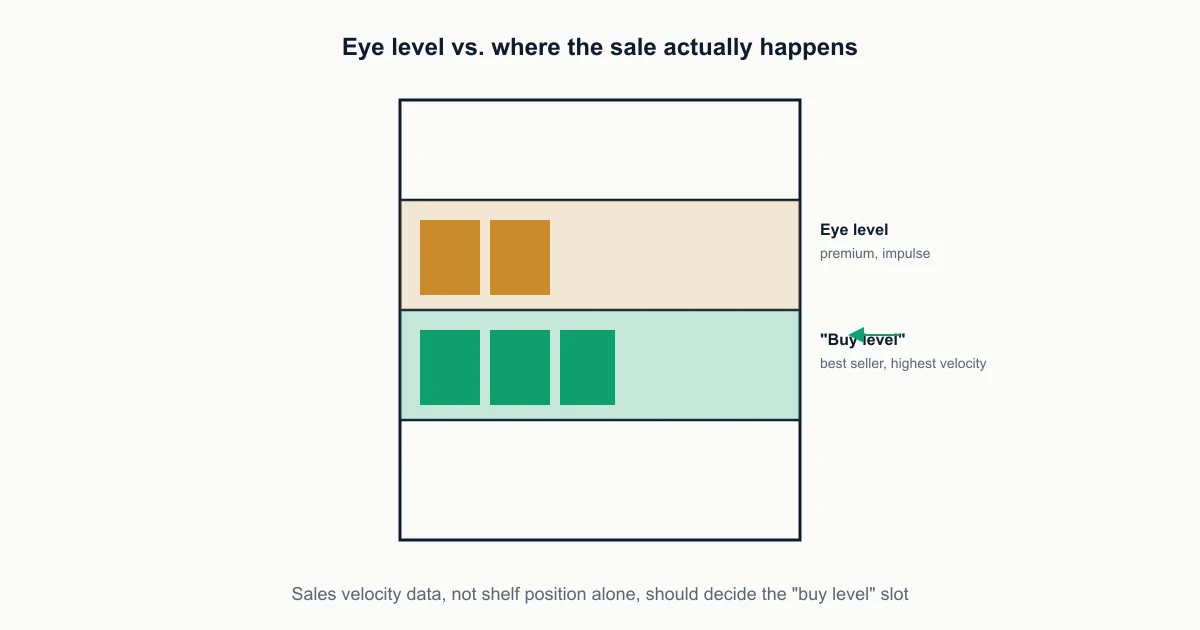
"Eye level is buy level" is one of the oldest sayings in retail merchandising, and like most sayings that stick around for decades, it's rooted in something real while also getting treated as more absolute than the underlying evidence actually supports.
What's genuinely behind the saying
Products positioned at a shopper's natural eye line get noticed faster and with less effort than products above or below it — this is a basic, well-supported finding about visual attention, not a merchandising myth. Placement at eye level reduces the physical and cognitive effort needed to notice and consider a product, which matters most for impulse or low-involvement purchase decisions where a shopper isn't already specifically searching for that item.
Where the saying oversimplifies
It matters less for destination purchases. A shopper specifically looking for a product they already intend to buy will find it regardless of shelf height, within reason — eye level mainly influences discovery and casual consideration, not every purchase decision equally.
"Eye level" itself isn't a single fixed height. Average eye-line height varies by population and by the specific store's shopper demographics — a children's product category, for example, has a meaningfully different relevant eye level than a category aimed at adult shoppers.
It can be deliberately overridden for good reason. Heavy items are placed lower for safety regardless of eye-level advantage. Kids' products are sometimes placed at a lower height specifically to be at a child's eye level, not an adult's. The slogan assumes one universal shopper, when real merchandising often needs to account for several.
Retailers can and do sell eye-level position as a premium placement, which tells you the belief in its effectiveness is strong enough to be commercially valuable — but commercial demand for a position doesn't by itself prove its sales impact is uniform across every category and product.
How to use the principle without over-relying on it
- Reserve eye-level space deliberately for the products that most benefit from discovery-driven attention — new launches, higher-margin impulse items, or categories where casual browsing drives a meaningful share of purchases.
- Consider the actual relevant shopper's eye level for that specific category, rather than assuming one universal adult-eye-level standard applies everywhere.
- Override eye-level logic when safety, accessibility, or a specific category's needs call for it, rather than treating the principle as an inflexible rule.
- Measure actual sales impact where possible, since the strength of the eye-level effect can vary meaningfully by category, rather than assuming a uniform lift everywhere it's applied.
This overlaps with store inventory accuracy, which is worth checking if that's also part of your situation. A closely related question is decompression zone, which tends to come up around the same time. This connects to heat-mapping shopper dwell time — the two are usually worth planning together.
FAQ
Does eye-level placement matter equally for every product category?
No — it tends to matter more for impulse, low-involvement, or discovery-driven categories than for destination purchases a shopper specifically sought out regardless of shelf position.
Should the top or bottom shelf always be reserved for the weakest-selling items?
Not automatically — while eye level does tend to drive more casual attention, factors like weight (heavy items low), accessibility, and specific category logic can reasonably override a pure "eye level gets our best sellers" rule.
Is "eye level" the same height in every store?
Not necessarily — average shopper height can vary by population and region, and category-specific considerations (products aimed at children, for example) can mean the functionally relevant "eye level" differs by category even within the same store.


