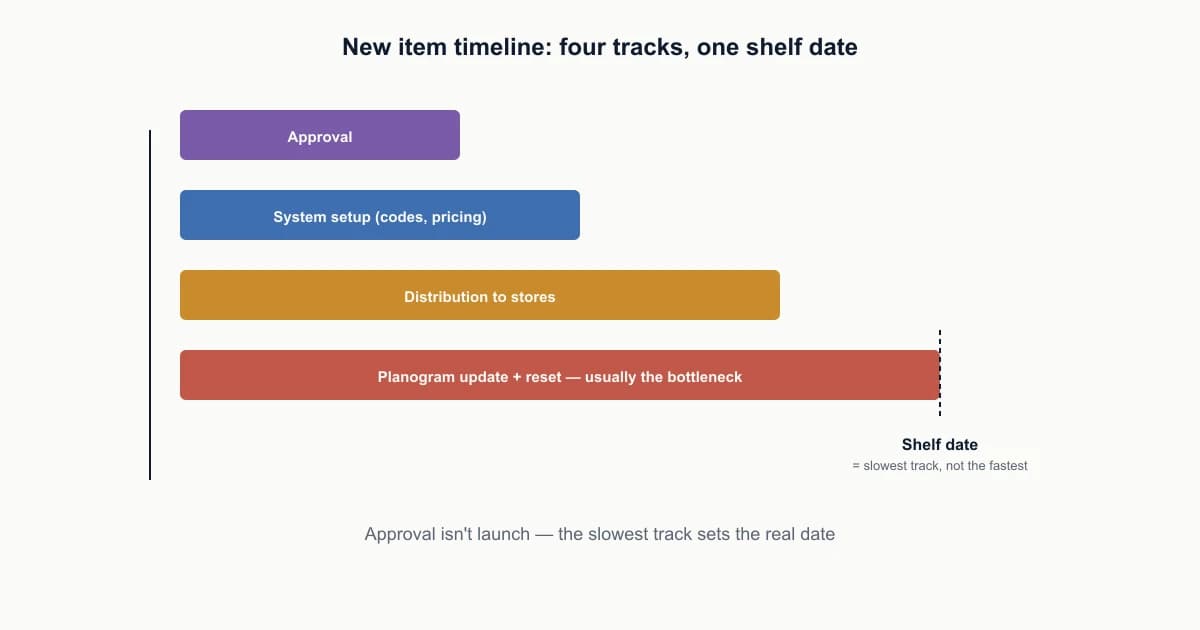
Getting a new product approved is often treated as the hard part, and getting it physically onto a shelf is treated as a formality that follows automatically. In practice, a new item introduction timeline into stores has several distinct steps between approval and a shopper being able to find the product, and a gap in any one of them delays the whole launch even after the "yes" decision is already made.
The steps that sit between approval and shelf
After a buying or category decision to list a product, it typically still needs system setup (item codes, pricing, barcodes active in the retailer's systems), distribution to reach the right stores with physical stock, and a planogram update that actually creates facing space for it. Each of these can run on a different timeline, and the slowest one sets the real launch date regardless of how fast the others move.
Why planogram cutover is often the bottleneck, not the product itself
A product can be fully set up in the system and sitting in a warehouse, but without a planogram update that creates space for it — and a reset that implements that update in stores — there's nowhere for it to actually go. Teams that plan the system and distribution timeline carefully but treat the planogram update as something that will "just happen" often find it's the actual constraint on launch date.
Planning a realistic timeline
- Confirm the planogram update is scheduled, not assumed, with a specific reset date tied to it — "we'll fit it in at the next reset" without a concrete date is how launches slip.
- Check whether the new item needs a full category reset or can be added via a smaller, targeted update — a full reset takes longer to schedule and execute, so knowing which one applies early changes the realistic timeline significantly.
- Account for distribution lead time separately from system setup time — a product can be fully set up in the system well before physical stock has actually reached store shelves, and the launch date needs to reflect whichever is slower.
- Build in a buffer for exceptions at individual stores — not every store resets on exactly the same schedule, and a national or regional launch date needs to account for stores that lag behind the lead timeline.
This pairs naturally with slotting fees and shelf space, which tackles a closely related piece of the same problem. This overlaps with returns and restocking, which is worth checking if that's also part of your situation. A closely related question is wine and spirits shelf planogram, which tends to come up around the same time.
FAQ
How long does a typical new item introduction take from approval to shelf?
It varies widely by retailer, category and whether a full reset is needed — there's no universal figure, which is exactly why mapping the specific steps for your situation matters more than assuming a standard timeline.
What's the most common cause of a delayed launch?
A planogram update or reset that wasn't firmly scheduled early enough, discovered only once the product and distribution were already ready — the reverse of what most teams expect to be the bottleneck.
Should a new item's facing count be fixed from day one?
It's reasonable to start with an initial allocation based on projected performance, with an understanding that it'll be revisited once actual sales data comes in — treating the launch facing count as permanent from the outset misses the chance to adjust based on real results.


