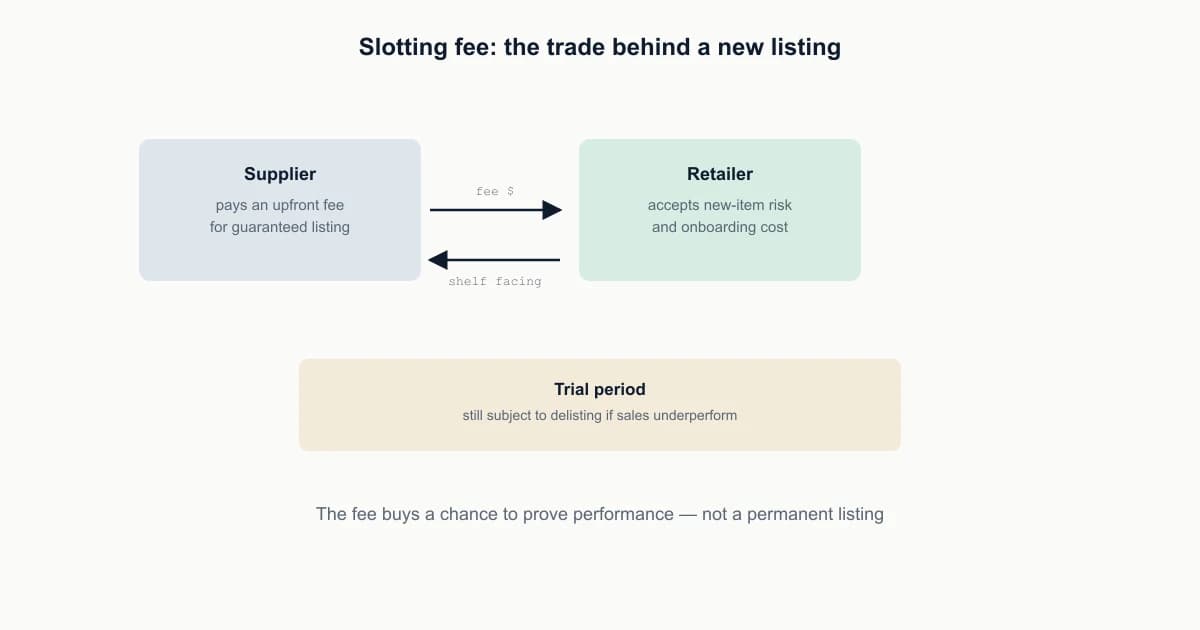
Shelf space is finite and retailers ration it, usually by sales performance and category strategy. Slotting fees and shelf space are connected by a more direct trade: a supplier pays an upfront fee for a retailer to guarantee a new product's placement, effectively buying a trial period a product might not otherwise earn purely on an unproven sales track record.
Why retailers charge for it at all
From a retailer's side, every new SKU added to a planogram carries real risk — it might underperform, and whatever it displaced might have sold better. A slotting fee partially offsets that risk and signals that the supplier has enough confidence in the product to back it financially, not just with a sales pitch. It also compensates the retailer for the administrative and logistical cost of onboarding a genuinely new item into their system.
Where it sits in the broader shelf-space picture
Slotting fees mainly apply to new product introductions, not to an established product's ongoing shelf position — once a product has a sales track record, its facing count is driven primarily by that performance data, the same as everything else on the planogram. The fee buys an initial chance to prove performance; it doesn't buy a permanent exemption from needing to actually sell once that trial period ends.
What suppliers and category teams should both understand about this
- The fee varies enormously by retailer, category and market, so there's no single standard figure to anchor expectations against — researching the specific retailer's practices matters more than assuming a general industry number applies.
- A slotting fee doesn't guarantee long-term shelf space, only an initial listing — a product that doesn't perform during its trial period is still exposed to delisting like any other underperformer, fee or no fee.
- Smaller or newer suppliers can find slotting fees a genuine barrier to entry, which is part of why some retailers offer alternative paths (smaller initial listings, test-market placement) for promising products that can't absorb a large upfront fee.
- Category captains and established suppliers sometimes have more leverage to negotiate reduced or waived fees, given their existing relationship and track record with the retailer, which can create an uneven playing field smaller suppliers need to plan around.
See new item introduction timeline for a related breakdown that often comes up alongside this. This pairs naturally with LED shelf lighting conversion, which tackles a closely related piece of the same problem. This overlaps with returns and restocking, which is worth checking if that's also part of your situation.
FAQ
Are slotting fees legal and common across the industry?
They're a long-standing, widely used practice in many markets, particularly in grocery and FMCG retail, though the specific regulations and norms vary by country and jurisdiction.
Does paying a slotting fee guarantee good shelf placement, not just any placement?
Not necessarily — the fee typically buys a listing, but exact facing count and shelf position still usually follow the retailer's normal planogram logic, which weighs category strategy and projected performance.
Can a product lose its shelf space even after a slotting fee was paid?
Yes — the fee covers the initial listing decision, not ongoing performance. A product that fails to meet sales expectations during its trial window remains subject to the same delisting process as any other underperforming SKU.


