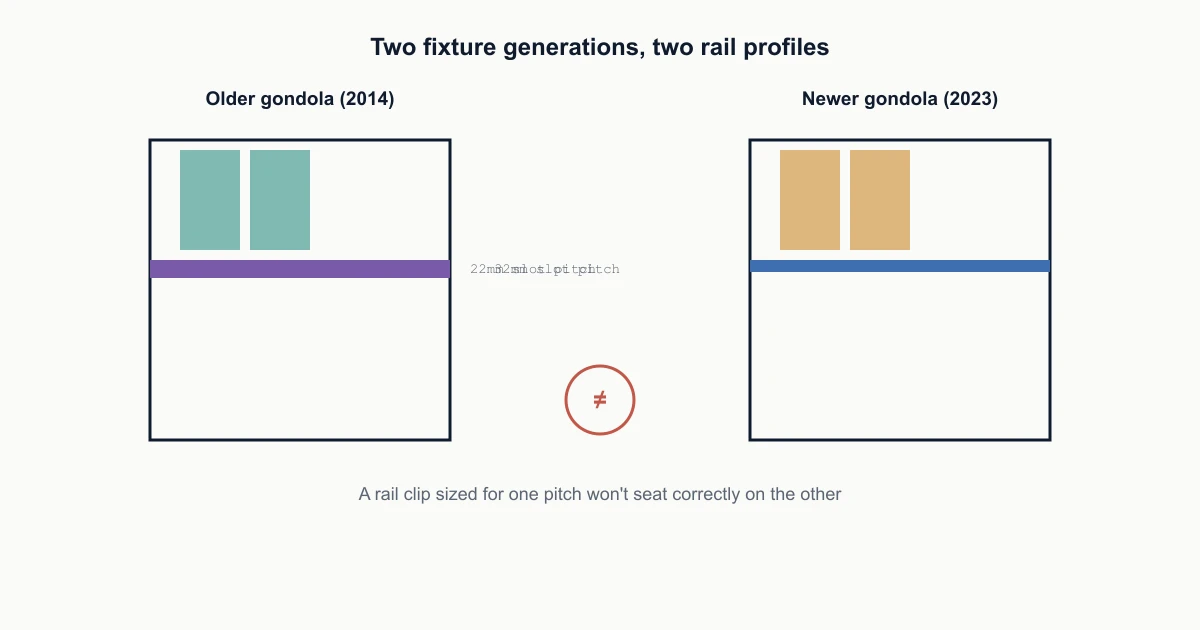
Price rail compatibility between an older and a newer fixture generation is one of those details that looks trivial until it isn't — a slightly different rail profile, clip spacing, or strip width between gondola generations can mean label strips from one era simply don't click into or slide onto the next.
Where this mismatch shows up
A store replaces or supplements fixtures without replacing every price rail at once. Partial fixture upgrades — a new section added to an older store, or a phased gondola replacement — commonly leave mismatched rail profiles sitting in the same aisle, each needing its own compatible label strip.
A manufacturer changes rail profile between product generations. Even fixtures from the same supplier can see a dimensional or clip-style change between generations, which isn't always obvious until someone tries to fit an existing label strip onto the new rail and it doesn't seat correctly.
Label strips get ordered against an assumed standard rather than the actual installed rail. If ordering doesn't confirm the specific rail profile in a given store or section, a bulk order of label strips can arrive incompatible with part of the fixture base they were meant for.
Why this is more disruptive than it sounds
A rail-and-strip mismatch isn't just an inconvenience — it directly affects pricing accuracy and, for sections without electronic labels, the only way pricing information reaches the shopper at all. A reset crew that discovers incompatible strips on reset day either has to delay completing that section or improvise a less secure, less professional-looking fix, neither of which is a good outcome.
Preventing the mismatch
- Confirm the actual rail profile for each fixture generation in use, rather than assuming a single standard across the whole store or chain.
- Track which sections or stores use which fixture generation, so label strip ordering can be matched to the correct specification rather than defaulting to one assumed standard.
- Test a sample strip against the actual installed rail before placing a bulk order, especially after any new fixture purchase or when sourcing from a new supplier.
- Flag mixed-generation sections explicitly in store records, so future resets and label orders don't repeat the same mismatch discovery on reset day.
A closely related question is LED shelf lighting conversion, which tends to come up around the same time. This connects to store inventory accuracy — the two are usually worth planning together. Worth checking next: color blocking as a merchandising technique, which covers a closely related part of the same decision.
FAQ
How common is it for a single store to have multiple fixture generations in use at once?
Fairly common, especially in stores that have undergone partial remodels or incremental fixture replacement over time rather than a single, complete gondola replacement across the whole store.
Can a mismatched label strip be forced onto an incompatible rail?
It can sometimes be forced into a loose, insecure fit, but this risks the strip falling off during normal shelf activity, which creates its own signage and pricing-accuracy problem down the line — matching the correct strip to the correct rail is the more reliable fix.
Who typically tracks which fixture generation is installed where?
This varies by retailer, but maintaining this as part of store fixture records — rather than relying on memory or assumption — is what prevents the mismatch from being rediscovered at every subsequent reset or label order.


