A field merchandiser covering a territory of stores only adds value at the stores they actually reach, and only in proportion to how much time they have once they get there. Route planning for field merchandisers isn't just a logistics detail — it directly determines how many stores get adequate coverage, how often each one gets visited, and whether the visits are long enough to do meaningful work instead of a rushed, superficial check.
Balancing visit frequency against visit depth
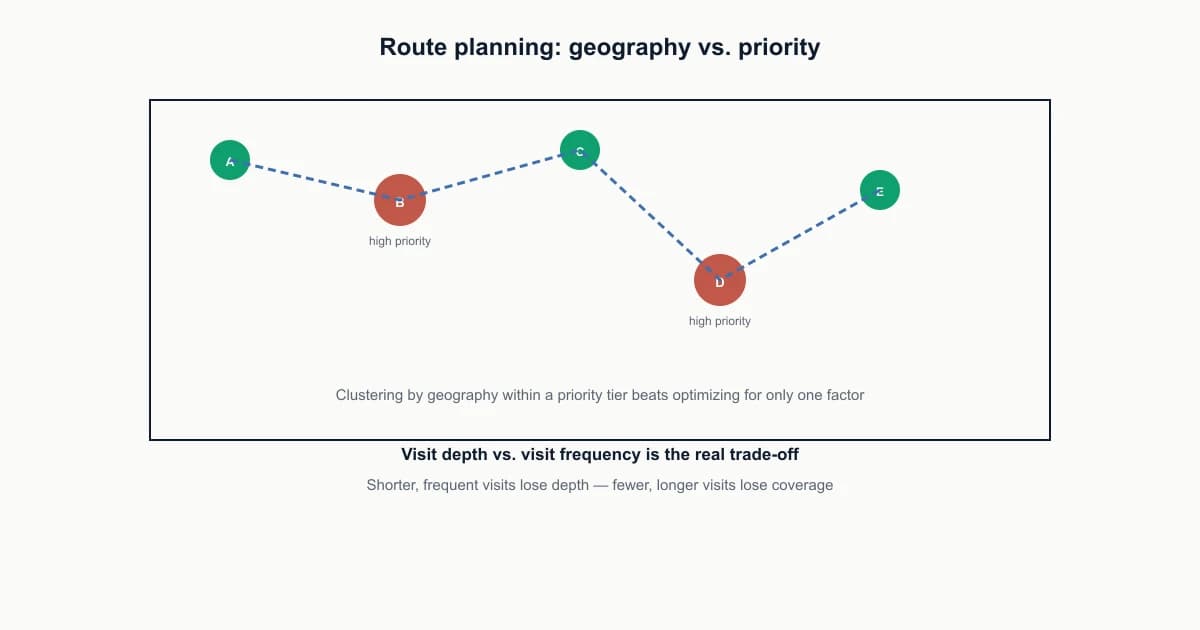
A route built to maximize the number of stores visited per day often does so by shortening each individual visit, which can turn a planned compliance check and restock into a rushed walk-through that catches little. A route built around fewer, longer visits improves depth per store but reduces how often any single store gets covered. The right balance depends on what each store actually needs — a high-priority, high-traffic store may justify shorter, more frequent visits, while a lower-priority store may be better served by a less frequent but more thorough one.
Geographic clustering versus priority-based sequencing
Pure geographic efficiency — visiting stores in the order that minimizes driving time — competes with priority-based sequencing, where the stores with the most pressing issues or highest sales impact get visited first regardless of route efficiency. Most well-run territories find a middle ground: geographic clustering within a priority tier, rather than optimizing purely for one factor at the expense of the other.
What actually makes a route sustainable over time
- Build in realistic buffer time for unexpected issues at any given store — a route scheduled with zero slack means one problem store running long cascades delays through the rest of the day's visits.
- Revisit route assignments periodically as store priorities change, rather than treating an initial route plan as permanent — a store that used to be low-priority can become a bigger focus after a reset, a new product launch, or a run of compliance issues.
- Account for realistic travel time, not optimistic best-case driving estimates, since a route planned on unrealistic timing sets merchandisers up to be perpetually behind schedule.
- Give merchandisers some visibility into why the route is sequenced the way it is, since route logic that seems arbitrary from the field is harder to trust and follow consistently than one the team understands.
This is closely tied to aisle width and accessibility code, and the two often need to be solved at the same time. If this is a recurring issue in your stores, case pack rounding problem covers a closely related angle worth checking. See click-and-collect locker placement for a related breakdown that often comes up alongside this.
FAQ
Should every store in a territory get the same visit frequency?
Not usually — higher-priority, higher-traffic or currently problematic stores often justify more frequent visits than a stable, low-issue store, and treating every store identically tends to under-serve the ones that need more attention.
How much slack should be built into a daily route?
Enough to absorb a typical unexpected delay without derailing the rest of the day's schedule — the right amount depends on how variable visit length tends to be across your specific store mix.
Does route planning software add real value over manual scheduling?
For larger territories with many stores, route optimization tools can meaningfully improve efficiency over manual planning, though smaller territories may get adequate results from straightforward manual route management.


