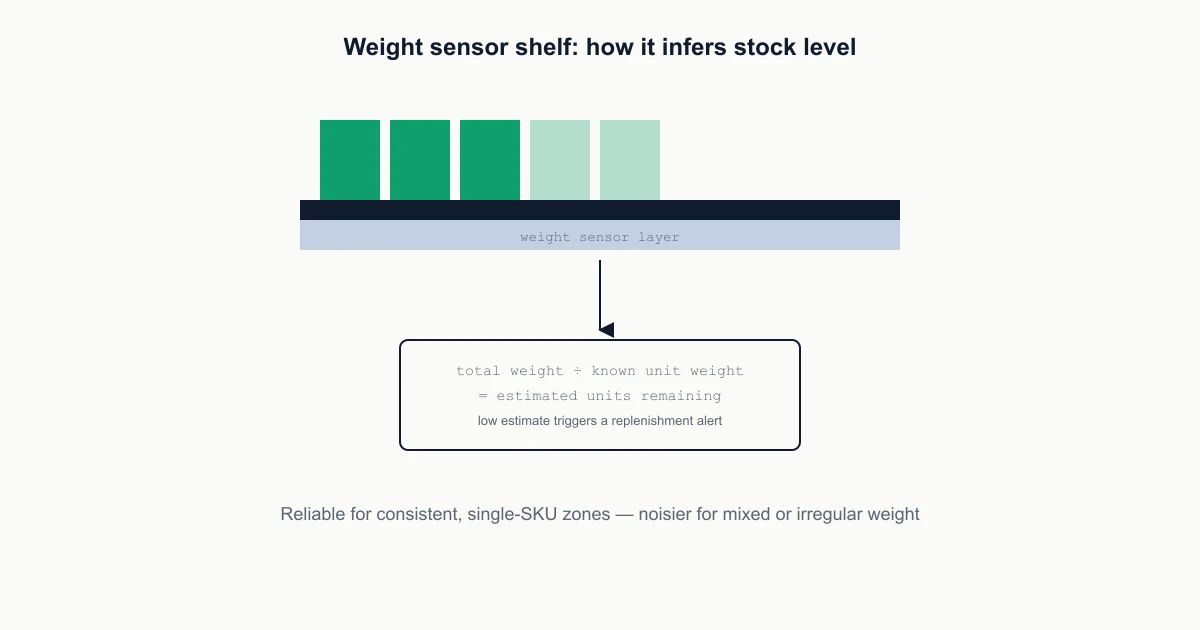
A weight sensor built into a shelf or shelf tray measures how much total weight is sitting on it, and infers stock level by comparing that weight against the known weight of a single unit. Smart shelf weight sensors for stockouts are one of several technologies competing to solve the same basic problem — knowing a shelf is running low without a person having to physically check it — but the weight-based approach has a distinct set of strengths and blind spots compared with RFID tags or camera-based systems.
What weight sensing actually measures well
Weight sensors are particularly reliable for products with a consistent per-unit weight and a simple, countable shelf arrangement — bottled or canned goods, boxed products, anything where "weight divided by known unit weight" gives a clean, trustworthy estimate of remaining units. The technology doesn't need line-of-sight the way a camera does, and it doesn't require tagging individual units the way RFID does, which keeps the per-SKU implementation cost relatively low once the shelf hardware itself is in place.
Where weight sensing runs into real limits
Products with inconsistent packaging weight, irregular shapes, or where shoppers commonly pick up and put back an item (changing the weight reading without an actual sale) all create noise the system has to account for. A shelf with mixed SKUs of different weights sitting in the same sensing zone, rather than one SKU per defined zone, also complicates the math considerably — the sensor can tell you total weight changed, but not necessarily which specific product caused the change if the zone isn't cleanly segmented.
Deciding where this technology is actually worth deploying
- It tends to earn its cost fastest on high-velocity, high-stockout-risk categories where a timely low-stock alert prevents a meaningful, recurring sales loss — deploying it broadly across slow-moving, low-risk categories dilutes the return on a real hardware investment.
- Clean, single-SKU shelf zones get far more reliable readings than mixed zones, so the planogram itself needs to support the sensor technology, not just the other way around — a layout built for weight sensing benefits from simpler, more segmented facings.
- It complements rather than replaces a human audit routine, since it's good at flagging "this zone's weight dropped significantly" but less good at confirming why, or at catching issues the sensor isn't designed to detect, like a misplaced or mislabeled product.
- Integration with replenishment systems is what turns a raw alert into an actual operational improvement — a weight sensor that flags a problem with no connected workflow to act on it doesn't deliver much beyond what a regular compliance walk already provides.
This overlaps with point-of-sale data lag, which is worth checking if that's also part of your situation. A closely related question is computer vision shelf monitoring, which tends to come up around the same time. This connects to switching distributors and case pack changes — the two are usually worth planning together.
FAQ
How does weight sensing compare with RFID for stockout detection?
RFID can identify individual tagged units precisely but requires tagging cost and infrastructure per item; weight sensing avoids per-unit tagging but trades away some precision, especially in mixed-SKU or irregular-weight scenarios.
Does every category benefit equally from weight-sensing shelves?
No — it works best on consistent, countable, single-SKU-per-zone categories. Categories with highly variable packaging or frequent shopper handling without purchase tend to generate noisier, less reliable readings.
Is this a replacement for regular shelf audits?
It's better understood as a complement — it can reduce how often a full manual audit is needed and catch stockouts faster between audits, but it doesn't fully replace the broader checks a human audit covers, like compliance and correct product placement.


