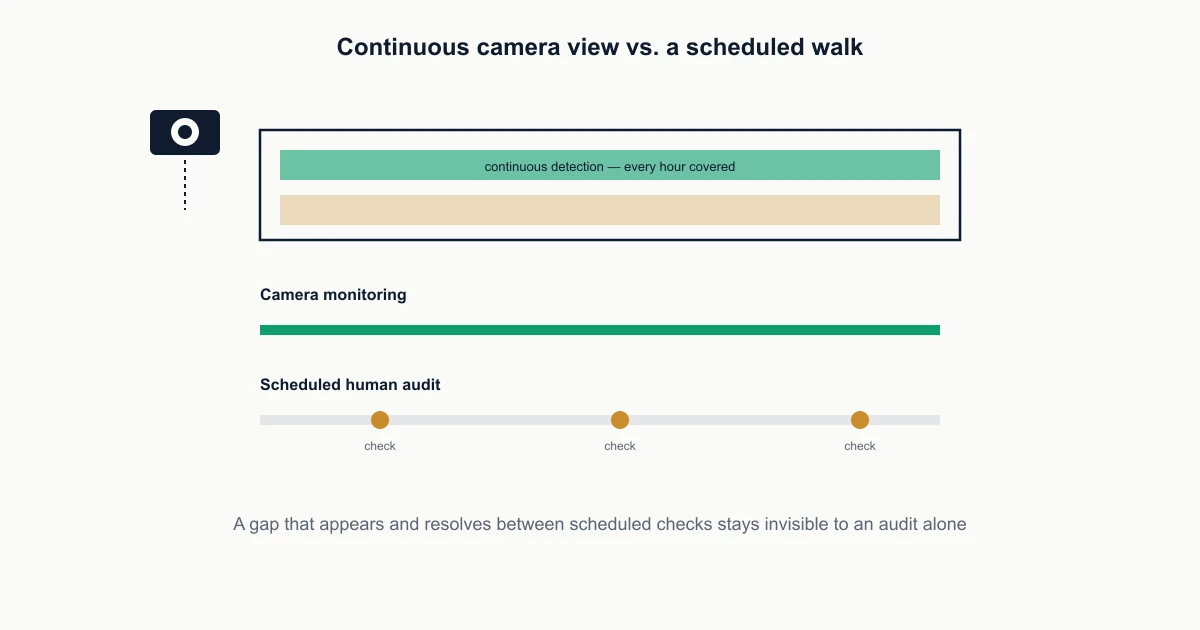
Fixed cameras paired with image recognition software can continuously scan shelf sections and flag issues — a gap, a misplaced product, an incorrect price tag — without waiting for a scheduled human walk-through to catch them. Computer vision shelf monitoring doesn't replace a person's judgment entirely, but it changes the detection timeline from periodic spot-checks to something closer to continuous awareness.
What it catches that a scheduled audit structurally can't
A human audit, however well run, only sees a shelf's state at the specific moment someone walks past it. A problem that appears an hour after the last audit and gets resolved before the next one is invisible to that audit process entirely, even though it may have cost real sales during the gap. Continuous camera monitoring closes that visibility gap, catching issues as they emerge rather than only at scheduled checkpoints.
Where the technology's judgment is still limited
Image recognition is generally strong at detecting whether a facing is present or missing, and increasingly capable at recognizing specific products. It's weaker at judging more subjective compliance questions — whether a shelf "looks" properly faced and tidy in the way a trained human eye would assess, or whether a technically-present product is placed in a way that still looks wrong to a shopper. Most deployments work best as a detection layer that flags likely issues for a person to verify or act on, not a fully autonomous replacement for human judgment.
Practical considerations before deploying it
- Coverage and camera placement determine what the system can actually see — blind spots, awkward angles, and poor lighting all degrade recognition accuracy, so the physical camera setup matters as much as the software behind it.
- False positives have a real cost in staff trust — a system that frequently flags non-issues trains staff to ignore its alerts, which defeats the purpose of continuous monitoring entirely.
- Integration with an actual response workflow is what makes the detection useful — an alert that doesn't route to someone who can act on it quickly is just data without operational value.
- Privacy and in-store camera policies need to be addressed directly, since shelf-monitoring cameras in a public-facing retail space raise different considerations than a purely back-of-house inventory system.
A closely related question is qr codes on shelf tags, which tends to come up around the same time. This connects to case pack rounding problem — the two are usually worth planning together. Worth checking next: moq vs shelf capacity, which covers a closely related part of the same decision.
FAQ
Does computer vision shelf monitoring replace human compliance checks?
Not fully — it's best understood as a continuous detection layer that surfaces likely issues faster, while a person still verifies and resolves what gets flagged, and still handles judgment calls the system isn't built to make.
How accurate is image recognition for detecting specific out-of-stock products?
Accuracy varies by product packaging consistency, camera angle and lighting, and generally continues to improve as the underlying technology matures — it's worth evaluating accuracy claims against your own specific fixture types and lighting conditions rather than a vendor's general benchmark.
Is this technology only practical for large chains?
Cost and complexity have historically favored larger operations with the budget and store count to justify the investment, though the technology has become more accessible over time — it's still worth weighing against simpler alternatives like photo audits for smaller operations.


