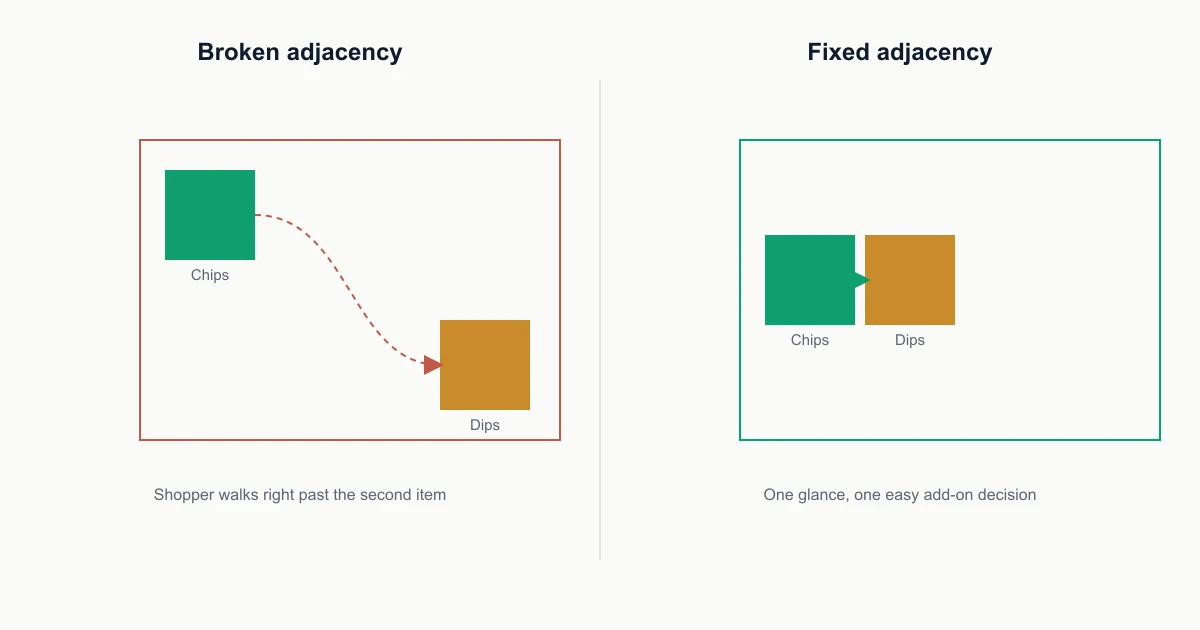
Wrong product adjacency means two categories that shoppers naturally buy together are no longer next to each other on the floor — chips moved away from dips, pasta sauce moved away from pasta, charcoal moved away from lighter fluid. The shopper who would have grabbed both now only grabs one, because the second item was never in their line of sight.
This isn't a cosmetic problem. Adjacency is one of the few merchandising levers that increases basket size without a price cut or a promotion. When it breaks, the loss doesn't show up as a complaint — it shows up as a slightly smaller basket, category after category, that nobody traces back to the shelf.
How adjacency breaks without anyone deciding to break it
Adjacency rarely breaks on purpose. It breaks through small, individually reasonable decisions:
- A category grows and needs an extra bay, so it eats space from whatever is next to it — pushing a complementary category further away.
- A reset crew runs short on time and reassembles fixtures in whatever order is fastest, not the order the plan specified.
- A new product line launches and gets dropped into whatever gap is open that week, not the gap the category plan intended.
- A remodel changes the store's footprint, and categories get reassigned to new aisles based on available space rather than shopper logic.
Each of these is a small, locally sensible call. None of them feels like "breaking adjacency." But add them up over a year and a store's layout drifts a long way from the plan that was built around how people actually shop.
What a broken adjacency actually costs
The mechanism is simple: shoppers build a mental list before they walk in, and they fill it in the order the store presents it to them. If item B isn't near item A, a meaningful share of shoppers simply won't make a separate trip across the store for it — they'll either skip it or buy it somewhere else entirely.
Retail trade press and planogram vendors consistently point to broken cross-sell adjacencies as a basket-size problem rather than a distribution problem — the product is in the store, it's just not where the shopper's path puts it. That distinction matters: a distribution fix (get the SKU listed) doesn't solve an adjacency problem (get the SKU seen at the right moment).
Rebuilding adjacency on purpose
Fixing this isn't about redesigning the whole floor. It's about treating adjacency as a rule that gets checked, not assumed:
- Write the adjacency logic down. If "snacks follow the beverage decision tree" is only in someone's head, it will drift the first time that person is on leave during a reset.
- Flag adjacency-critical categories on the planogram itself, not just in a separate strategy document, so the people executing the reset can see the dependency.
- Check adjacency after every reset, not just after the big annual one. Small category growth is the most common silent cause of drift.
- When space is genuinely tight, break the right adjacency. Not every pairing matters equally — know which ones actually move the basket before you sacrifice one for space.
This overlaps with product placed next to the wrong category, which is worth checking if that's also part of your situation. A closely related question is private label shelf position, which tends to come up around the same time. This connects to supplier resizes a pack — the two are usually worth planning together.
FAQ
What is product adjacency in retail?
Product adjacency is the placement of complementary categories or items near each other on the shop floor — for example, placing chips next to dips — so a shopper buying one is naturally prompted to buy the other.
How do I know if my adjacency is actually driving sales?
Compare basket data for shoppers who bought the "anchor" category against the attach rate of the complementary category before and after any layout change. A falling attach rate after a reset is a strong signal the adjacency has broken.
Does adjacency matter more in some categories than others?
Yes. Adjacency has the biggest impact on impulse and "remind me" purchases — items a shopper didn't plan to buy but will when they see them next to something they did plan to buy. Planned, destination purchases are far less sensitive to where they sit.
Who is responsible for keeping adjacency correct between resets?
In most stores, nobody owns this explicitly — it falls through the gap between the category plan and the people stocking shelves day to day. Making adjacency a visible, checkable rule on the planogram is the most reliable fix.


