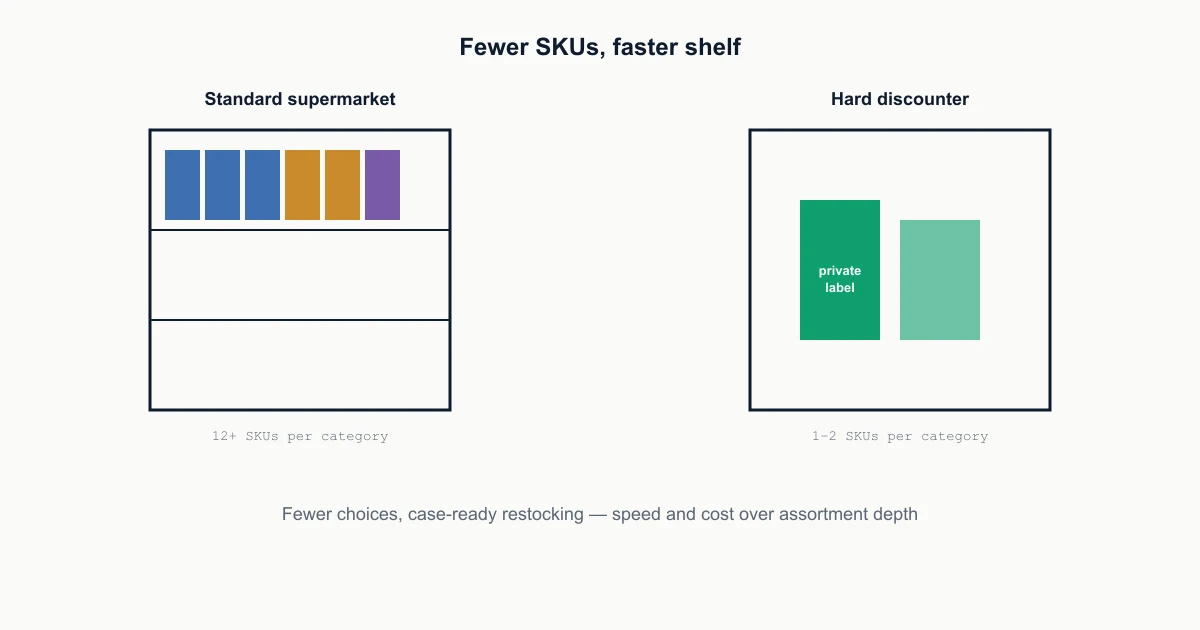
Most planogram advice is about fitting more into a fixture without crowding it. A hard discounter planogram runs on the opposite instinct: deliberately carrying far fewer SKUs per category than a standard supermarket, often just one or two options where a conventional store might carry a dozen, and using that restraint to drive faster restocking, simpler decisions and lower operating cost throughout the store.
Why fewer SKUs isn't a compromise in this format
In a standard supermarket, a narrow range is usually a problem to solve. In a hard discounter, it's the whole strategy — fewer SKUs means faster restocking per linear foot, simpler ordering and forecasting, and a shopping experience built around speed and trust in value rather than extensive choice. The planogram isn't trying to maximize assortment depth; it's trying to maximize throughput and cost efficiency per facing.
Case-ready and pallet-forward shelving as the default
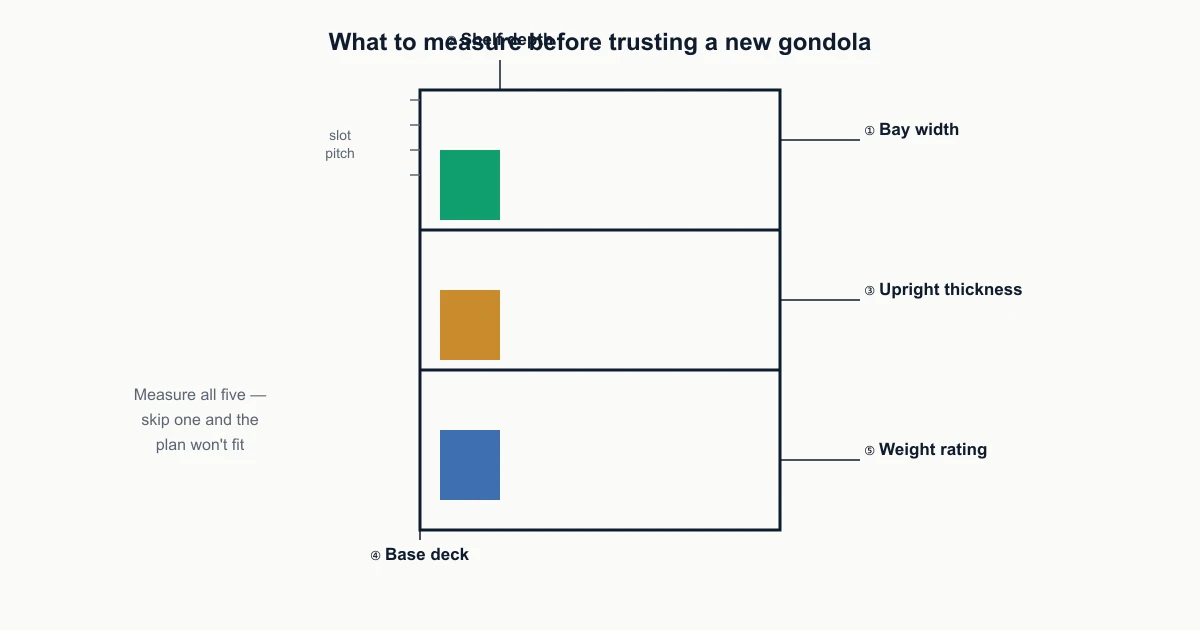
Hard discounters often restock directly from the shipping case or pallet rather than breaking every case down onto conventional shelving, which shapes the whole fixture choice. Planograms built for this format need to account for case dimensions as a first-class constraint, not an afterthought, since the shelf is frequently designed around the shipping unit rather than the other way around.
What this approach trades away, and what it protects
- Shopper choice within a category is intentionally narrow, which only works if the limited range genuinely represents strong value and acceptable quality — the format's credibility depends on shoppers trusting that trade-off, not just tolerating it.
- Private label dominates far more heavily than in a standard supermarket, often making up the large majority of facings in many categories, which simplifies supplier relationships and sourcing at the cost of brand variety.
- Promotional and rotating "deal of the week" space is often a larger, more central part of the format than in standard grocery, giving the limited core range a regular injection of novelty without expanding the permanent assortment.
- Labor efficiency is baked into the layout itself — wider aisles for pallet movement, minimal elaborate secondary displays, and fixtures chosen for fast restocking over polished presentation.
This pairs naturally with dollar store planogram, which tackles a closely related piece of the same problem. This overlaps with cash-and-carry wholesale, which is worth checking if that's also part of your situation. A closely related question is localizing planograms by store demographics, which tends to come up around the same time.
FAQ
Is a hard discounter planogram just a smaller version of a standard supermarket planogram?
Not really — it's built around a different core strategy (speed and cost efficiency over choice), which changes fixture selection, SKU count per category and restocking method, not just the overall store size.
Does this approach work for every category?
It works best for staple, repeat-purchase categories where shoppers are comfortable with limited choice. Categories where shoppers expect genuine variety — like specialty or niche products — are a harder fit for the model and are often simply carried in smaller total range or left out.
Why do private label and the store's own brand dominate this format so heavily?
It gives the retailer more control over cost, sourcing and consistent quality at the format's target price point, and it reduces the complexity of managing many supplier relationships for a deliberately narrow range.