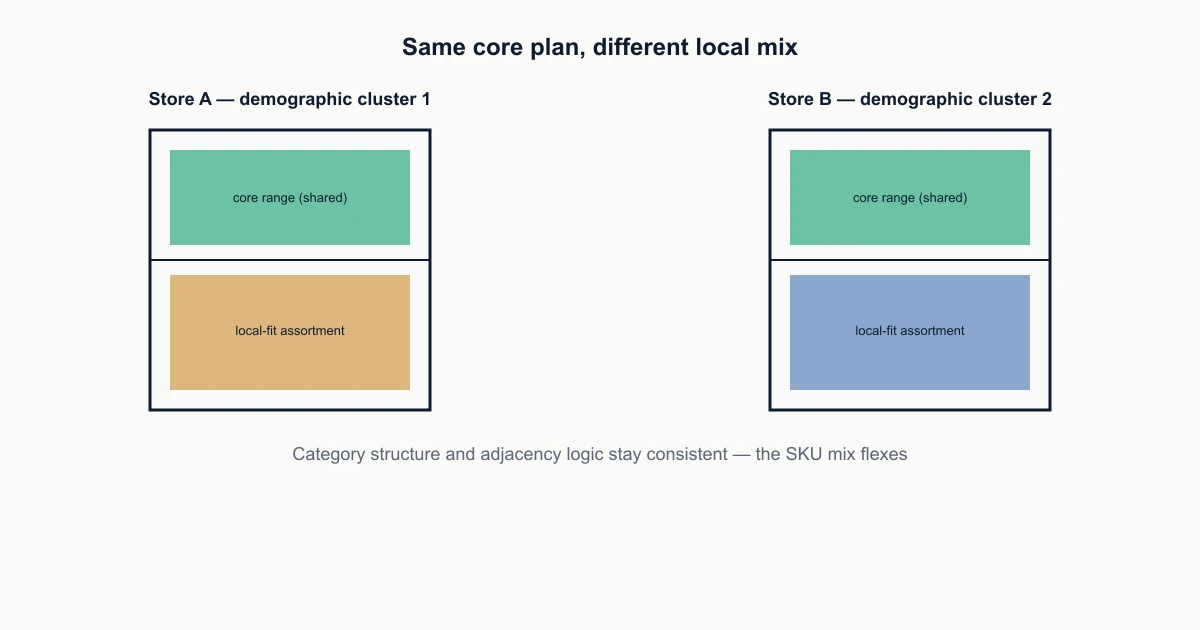
Two stores from the same chain, a few kilometers apart, can serve meaningfully different communities with different household sizes, cultural backgrounds and shopping habits. Localizing planograms by demographics means letting the assortment and facing mix flex to match the local shopper base, without turning every store into a bespoke layout that's impossible to manage centrally.
Demographics versus volume clustering — a different axis entirely
Clustering stores by sales volume groups them by how much they sell. Clustering by demographics groups them by who's buying — household size, cultural background, age distribution, income level — and those two groupings don't always line up. A high-volume store and a low-volume store can serve nearly identical demographics and need very similar assortment logic, just at different facing scales, while two similarly-sized stores can need genuinely different product mixes because their local shopper bases differ.
Where localization earns its keep and where it doesn't
Demographic localization tends to pay off most in categories with genuine cultural or household-size variation — international and ethnic food sections, household product pack sizes, baby and family categories, and categories with strong regional taste preferences. It pays off far less in categories that are fairly universal regardless of who's shopping — basic staples, cleaning supplies, most health and beauty essentials — where forcing variation mostly adds operational complexity without a real sales benefit.
Keeping it manageable at scale
- Define a small number of demographic-driven variants, not one plan per store — a handful of well-reasoned cluster variants is maintainable; hundreds of individually customized store plans usually isn't, no matter how good the local fit is in theory.
- Keep the core category structure and adjacency logic consistent across variants, and localize mainly at the SKU and facing-count level — this keeps store teams and shoppers who visit multiple locations from facing a genuinely different shopping experience store to store.
- Validate assumptions against actual local sales data, not just demographic data alone — assumed preferences based on demographics can be wrong, and real sales performance should have the final say over a plan built purely from assumption.
- Revisit demographic clusters periodically, since neighborhoods change — a cluster assignment made years ago based on outdated local data can steer a store's assortment away from what its current shopper base actually wants.
This overlaps with dollar store planogram, which is worth checking if that's also part of your situation. A closely related question is hard discounter planogram, which tends to come up around the same time. This connects to how to cluster stores for planograms — the two are usually worth planning together.
FAQ
How is this different from clustering stores by sales volume?
Volume clustering groups stores by how much they sell; demographic clustering groups them by who's buying. The two can overlap but often don't, and a sophisticated planning approach usually considers both rather than relying on just one.
Does every category need demographic localization?
No — it's most valuable in categories where local shopper preferences genuinely vary, and mostly unnecessary overhead in universal, low-variation categories where one standard plan serves every store well.
What's the risk of over-localizing?
Operational complexity that outweighs the sales benefit — too many unique store-level variants becomes hard to maintain, audit for compliance, and update consistently when the broader category strategy changes.